
Journal of Icon Studies, Volume 4 | Fall 2025
The Long Journey of the Jumati Medallions
by Mariam Otkhmezuri Charlton

Nine medallions in the collection of the Metropolitan Museum of Art, known as the “Jumati medallions,” once decorated a silver icon frame of the archangel Gabriel in the Georgian monastery of Jumati. Dated to around 1100 the busts depicting various saints are finely worked cloisonné enamels, composed on a gold ground, and are considered to exemplify the highest echelon of Byzantine craftsmanship. This paper examines the Jumati medallions from the standpoint of provenance, retracing their journey to their present location. The investigation tells a complicated story in which colonial practices of acquisition are intermingled with the formation of private collections and the development of Byzantine Studies.
Mariam Otkhmezuri Charlton is an MA student in Art History at Hunter College, City University of New York. Originally from Tbilisi, Georgia, she earned her BA in History from Ivane Javakhishvili Tbilisi State University, where she focused on Russia–Georgia relations. Her research takes an interdisciplinary approach to understanding artworks within broader social, historical, and political contexts. She is particularly interested in the histories of collecting, exhibitions, and museums, as well as cross-cultural artistic exchange.
Recommended Citation: Mariam Otkhmezuri Charlton, “The Long Journey of the Jumati Medallions,” Journal of Icon Studies 4, 2025
The text of this work is licensed under a Creative Commons Attribution 4.0 International License (CC BY 4.0). All images are reproduced with the permission of the rights holders acknowledged in captions, or are reproduced under license, and are expressly excluded from the CC BY license covering the rest of this publication. These images may not be reproduced, copied, transmitted, or manipulated without consent from the owners, who reserve all rights, and outside the terms of any specified license.

Enamel, Jumati Monastery, Nikodim Kondakov, Byzantine Art, Alexandr Zwenigorodskoi.
Nine medallions from an icon frame in the collection of the Metropolitan Museum of Art, New York, are considered some of the finest extant examples of Byzantine enamel and have garnered significant scholarly attention since the late nineteenth century [fig. 1]. [1] The medallions depict Christ, the Virgin, John the Baptist, and other Christian saints. They were originally part of a larger set, surrounding a now-lost icon of the Archangel Gabriel, held at the Jumati Monastery in Georgia. [2] While much has been written about the Jumati medallions’ art-historical significance, this paper centers on the objects’ movement from a remote monastery to a museum collection. Drawing on archival documents and non-English publications, my research reveals the complex and often problematic ways in which the medallions changed hands. I highlight the intertwined issues of fraudulent art-acquisition practices, the formation of private art collections, and the development of Byzantine art scholarship in the late nineteenth and early twentieth centuries.

c. 1100, Constantinople. From the Jumati Monastery, Republic of Georgia.
Each 8.3 cm (diam.). Gift of J. Pierpont Morgan, 1917.
The Metropolitan Museum of Art, Inv. Nos. 17.190.670-.678.
Description
The medallions are displayed in the Apse Gallery of the Metropolitan Museum, which features Byzantine icons and objects of devotion [fig. 2]. Each roundel measures 3 1/4 inches (8.3 cm) in diameter and features colorful cloisonné enamel set in gold.[3] Each depicts a half-length holy figure that can be seen as a small individual icon. Greek inscriptions in black enamel on either side of the heads identify the figures.

Mary and Michael Jaharis Galleries for Byzantine Art,Metropolitan Museum of Art.
Photo by the author.
In their original setting, the medallion featuring Christ Pantokrator (Ruler of All) with a cruciform halo would have been flanked by those showing the Virgin Mary and Saint John the Baptist, who both turn toward Christ in prayer, forming a traditional triad known as the Deesis. Mary’s and John’s similar three-quarter poses as they raise their hands in prayer toward Jesus contribute to the harmonious composition. The other medallions of various saints create a sense of spiritual unity and connection, so that the central figures’ intercessory prayers are supported by the ranks of apostles, evangelists, and theologians, and the military saints in the order they are invoked during the Divine Liturgy.[3]
Striking are the figures’ peculiar side glances. Christ’s gaze is directed toward John, who would have been placed to his left, denoting his acknowledgment of the Baptist’s petition. In the hierarchic order in which the saints are currently arranged, which likely echoes their original placement around the icon frame, their eyes are turned toward the now-missing central image. These glances highlight the ability of saints to communicate with the divine and to receive and transmit viewers’ prayers—the primary feature of the Byzantine icon.
The gold cloisons (dividing strips) that articulate the figures indicate volume as well as providing outlines. They are laid in repeated parallel lines, curves, and herringbone designs to indicate folds of fabric. The enamels feature a wide range of colors: dark blue, light blue, green, golden yellow, red, white, and black, with the faces and hands rendered in a brownish-pink flesh tone. The figures’ halos also are all outlined in red, but their fill colors range from emerald green to blue-green and sapphire blue, and they are patterned with small crosses and dots.
The saints, including Peter, Paul, John the Evangelist, Matthew, and Luke, are dressed similarly in blue-gray tunics with vertical bejeweled stripes (or stoles) and dark blue mantles; this uniformity in dress symbolizes their collective mission to spread the Gospel. Fittingly, all the saints (except for the Baptist and Peter, who holds a staff with a cross on top) are depicted holding Gospel books or related attributed, rendered in perspective, with each book bearing a unique cover design. John the Evangelist and Matthew look alike and are shown with more mature features. One can even make out wrinkles on the elderly saints’ foreheads. Some of the white color of their hair and beards has a wonderful blue tint. In contrast, Saint George is depicted as a beardless youth holding a cross as a symbol of his martyrdom. Moreover, Saint George’s attire further distinguishes him from the other saints: he wears a red mantle with a festive pattern of ivy leaves or inverted hearts.
Much has been written about the exceptional skills of Byzantine artists working with cloisonné enamel. According to the pre-Revolutionary Byzantinist Nikodim Kondakov (1844–1925), the technique of enameling was probably kept a secret, passed from one goldsmith to another.[5] A skilled enameller was a combination of a goldsmith who could articulate forms with tiny gold cloisons, an artist who could create a design, and a chemist or alchemist who could achieve the desired colors by mixing different ingredients at the right temperatures. However, these masters are anonymous today; no list of royal workshops with the names of enamellers has been found.[6] Some of the best examples of this elaborate practice are from the middle Byzantine period (843–1204), when icon making flourished again after the resolution of the prolonged disputes concerning the permissibility of devotional images during Iconoclasm.
The Orthodox faithful viewed icons as sacred objects that held a divine imprint, with their medium often enhancing their spiritual significance.[7] Icons could be made with various techniques, including painting, ivory and gemstone carving, mosaic, and metalwork, with cloisonné enameling considered one of the most challenging and prestigious methods. When executed successfully, cloisonné enamel produced jewellike treasures. Art historian Bissera Pentcheva suggests that enameled icons ideally embody the concept of the icon as an imprint of the divine. She explains that the use of enamel, which involves the imprinting of fire on material, aligns with the idea of the icon as a physical manifestation of divine presence, especially after the articulations of icons’ proper role post Iconoclasm.[8]
As mentioned earlier, the identities of Byzantine enamellers and the production dates or locations of their workshops are typically undocumented. Nineteenth-century scholars, especially Kondakov, associated the Jumati medallions with the early eleventh century, a period considered the peak of Byzantine enamel artistry.[9] Later scholarship has revised this dating; the Metropolitan Museum now attributes them to the twelfth century. Art historian Margaret Frazer had proposed a more specific date range, placing the medallions at the end of the first quarter or beginning of the second quarter of the twelfth century. She notes similarities in the patterning of the cloisons on the Jumati medallions to those seen in the fragmentary feast cycle of the Pala d’Oro in Venice, suggesting they date to the same period. Additionally, Frazer observes resemblances between the treatment of faces on the medallions and the imperial portraits of John II, Irene, and Alexius in the mosaics of the Hagia Sophia in Istanbul, dated to around 1118–22.[10]

Maria (from the Icon of the Virgin of Khakuli), 11th Century.
7. 2 x 7 cm. Tbilisi, National Museum of Georgia.
Most scholars believe that the Jumati medallions, due to their high quality, were produced in the royal workshop in Constantinople and that they may have been sent to Georgia as a gift in connection with an imperial marriage.[11] An example of a similar gift may be the cloisonné enamel plaque representing Emperor Michael VII Ducas (r. 1071–78) and his wife, Maria, a Georgian-born royal princess [fig. 3]. The plaque is part of a decorative ensemble of cloisonné enamels of the icon of the Virgin of Khakhuli (the Khakhuli Triptych), which includes a large number of enamels of both Georgian and Byzantine origin [fig. 4a]. The possibility that the Jumati medallions were sent from Constantinople to Georgia, either as part of a royal marriage exchange or as diplomatic gifts, underscores the close political and cultural relationships between the Georgian Bagrationi dynasty and the Byzantine Comnenus family during the twelfth century.[12]


Supporting the likelihood of their Byzantine origin is the exceptional quality and formal rigor of the design and the fact that the inscriptions are in Greek. However, the carefully enameled elegant script does include some errors and nonstandard spelling. For example, the inscription identifying Paul is missing the upsilon v from his name (it read as PALOS, instead of PAVLOS); the letter alpha a is missing from ÁGIOS (saint) on Luke’s medallion; Matthew’s name is misspelled as MANTHEOS instead of ΜΑΤΘΑΙ͂ΟΣ, and in George’s name, the letter omicron o is used instead of the omega ω, so it appears as ΓΕOΡΓΙΟΣ and not ΓΕΩΡΓΙΟΣ. Christ’s medallion, inscribed with the traditional Christogram IC XC —an abbreviation of the Greek words Ἰησοῦς Χριστός—and uses the lunate sigma (Ϲ). On other medallions, however, the shape of the final “S” in the saints’ names takes on an unusual form: it resembles the titlo, a curved abbreviation mark, seen above Ѳ҃Ѵ in the inscription М҃Р Ѳ҃Ѵ on the Virgin’s medallion. The enameller may have adapted this form to make the script appear more visually harmonious. Georgian scholars believe that the medallions might be the work of a pro-Byzantine Georgian enameller.[13] Greek inscriptions are not uncommon on wall paintings in Georgian medieval churches or manuscripts, likely reflecting the artists’ Byzantine training or Greek origin. Sometimes, both Greek and Georgian inscriptions appear on the same cloisonné enamel panels, suggesting the enameller’s proficiency in both languages [fig. 4b].[14] In addition to the unusual spelling of the Jumati medallions, there is another notable peculiarity in the enamel depiction of Christ Pantocrator—the hand holding the Gospels is veiled by drapery [fig. 5]. As Byzantine enamel scholar David Buckton observes, a draped hand grasping the Scriptures was a common visual device used to symbolize their inviolability. However, in the case of Christ, Buckton argues, this is both “theological and iconographic nonsense,” since it contradicts the notion that Christ, as the Word incarnate, should not be obscured in such a manner.[15] This detail could either be an honest mistake on the part of the enameller or the result of reliance on an iconographic source that remains unknown to us.[16]

enamel, c. 1100. 8.3 cm (diam.). The Metropolitan Museum of Art.
https://www.metmuseum.org/art/collection/search/464551.
The physical condition of the enamels is generally very good. While some of the inscriptions have faded over time, and the staff with a cross that Saint Peter is holding is missing some color, the enamels themselves remain intact, attesting to the durability of the medium. However, there is visible damage to the rim of Christ’s medallion, likely occurring when it was removed from a frame. Additionally, the notched borders of each medallion feature asymmetric pinholes—sometimes up to eight—which suggests they may have been attached to another object, possibly more than once, before being removed.
Jumati Monastery
Dimitri Bakradze (1826–1890), a Georgian historian, ethnographer, and archaeologist, was the first scholar to identify the Jumati medallions in the frame of the icon of Archangel Gabriel during his visit to the Jumati Monastery in 1874. In his study “An Archaeological Journey in Guria and Adjara,” published by the Russian Imperial Academy of Science in 1878, Bakradze provided a detailed account of the monastery’s history, architecture, and possessions. He began by underscoring the natural beauty and grandeur of its difficult-to-reach location on Jumati mountain. Upon reaching the peak, Bakradze was struck by the breathtaking, expansive views of sea and mountain range, remarking that it offered one of the widest vistas he had encountered throughout the Caucasus region.[17]


By the time of the scholar’s visit, the monastery was in decline. Its main church, dedicated to Archangels Michael and Gabriel, is a simple basilica with a semicircular apse [figs. 6a-b].[18] The church is surrounded by a stone wall, and the entrance to the yard is through the bell tower. The church’s age is uncertain, but it likely predates the formation of the Jumati diocese, which is thought to have occurred in the fifteenth century when Guria became an independent fiefdom. The diocese had once been wealthy, supported by local princely families and villagers and known for its valuable icon and relic collection. However, Jumati’s status diminished over the centuries, and in 1827 the diocese was abolished during the Exarchate period (1817–1917), when the Georgian Orthodox Church lost its independence under Russian rule. Despite this, the monastery remained the summer residence of the bishop of Guria until 1886. The murals inside the church have survived in fragments, dating from different time periods; in the nineteenth century, the upper part of the interior was whitewashed [figs. 7a-c].


According to a local legend, the founding of Jumati Monastery was connected to a devastating flood of the Paliastomi Lake.[19] A sudden deluge of water is said to have engulfed the village, drowning everyone except for a single deacon, who snatched an icon of an archangel from the local church and carried it up Jumati mountain, which lies about an hour’s drive from the lake. As the Georgian writer Egnate Ninoshvili recounts in his 1891 short story, “Paliastomi Lake,” the Jumati Church was built in honor of this miraculous icon. The deacon, whose last name is reported to be Darchia (translated from Georgian as “the one who remained”), became the priest of the church.[20] Not surprisingly, over the centuries many priests at Jumati have had the last name Darchia.
The legend does not specify which icon of the archangel was considered miraculous, but Bakradze’s account indicates that the church had several valuable icons of archangels.[21] Among them, he believed that a large silver gilt icon of Michael, adorned with ten cloisonné enamel medallions bearing Georgian inscriptions, and a large silver-gilt icon of Gabriel, featuring ten cloisonné enamel medallions with Greek inscriptions (the ones that interest us here), were likely made as a matching pair.[22] These icons were both significantly damaged. The Gabriel icon (105 × 35 cm) was split down the middle, while the Michael icon (106 × 71 cm) had “broken pieces hanging from it.”[23]


Fortuitously, we have contemporaneous photographs of these icons taken by Dimitri Ermakov, a renowned photographer from Tbilisi who visited Jumati in the 1870s [fig. 8a].[24] These provide crucial visual evidence that would otherwise be difficult to reconstruct based solely on textual descriptions. In the surviving image of Gabriel’s icon, we can clearly see the archangel depicted full length, winged, and dressed in imperial vestments; he wears the loros, a long, jewel-studded scarf wrapped around his body and draped over his left hand, and also holds an orb marked with a cross and a scepter with a square finial.[25] The archangel’s head, ringed with a halo, is slightly tilted. A small fragment of his face survives and is in the collection of the State Hermitage Museum in Saint Petersburg [fig. 9a].[26] His smooth face with stylized features, particularly the large linear eyes and nose, contrasts with the detailed rendering of his hair and wings and the intricate floral and geometric ornamentation of the background. Gabriel stands on a footstool, though this is barely visible. The background features two four-leaf enamel quatrefoil plaques (to which I will return) with abbreviated inscriptions in Georgian asomtavruli script: “Saint Gabriel” and “Chief Commander of Power” [figs. 9b-c]. On the top of the frame is the Deesis, and on its left-hand side are Saints Peter and Paul, with John and Matthew on the right.[27] The medallion depicting Luke is located between the broken fragments of Gabriel’s vestments, and Saint Mark appears to have been lost. At the bottom of the icon are placed three medallions with military saints, Theodore, George, and Demetrius. These saints are also honored in the church decoration, where one mural portrays them as young formidable figures, fully armored, standing together to emphasize the amity and unity among soldiers [fig. 10].

14th century. 10.5 x 6.5 cm. St. Petersburg, State Hermitage Museum, Inv. No.
Гру-14.
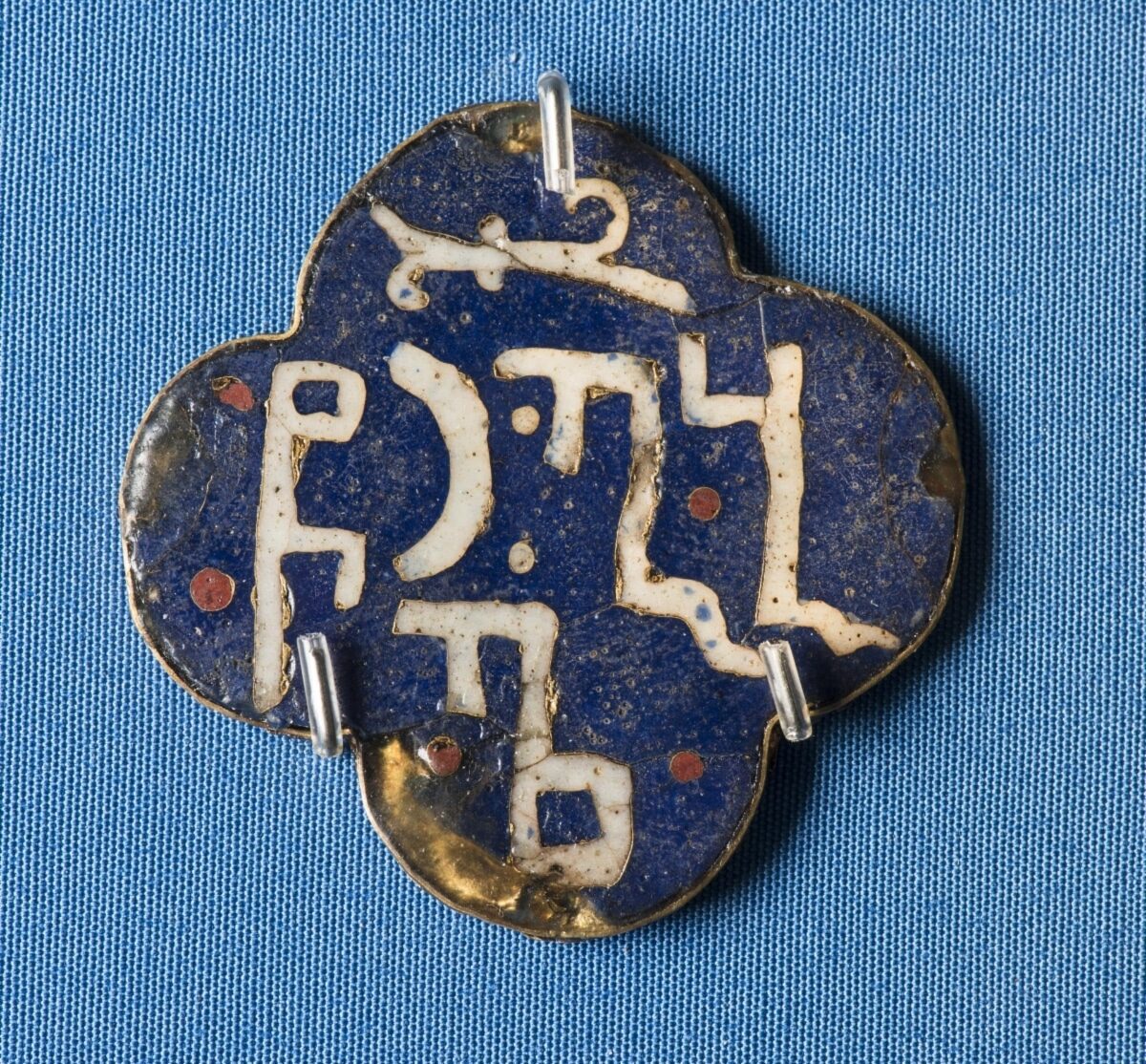
cloisonné enamel, 12th century, Georgia. 4.7 x 4.7 cm. St. Petersburg, State
Hermitage Museum. Inv. No. Гру-109. https://digital.hermitagemuseum.org/
wps/portal/hermitage/digital-collection/08.+applied+arts/109822.

cloisonné enamel. 12th century, Georgia. 4.3 x 3.1 cm. St. Petersburg, State
Hermitage Museum, Inv. No. Гру-110. https://digital.hermitagemuseum.org/
wps/portal/hermitage/digital-collection/08.+applied+arts/109823.
The icon of Archangel Michael highlights the theme of the heavenly army, with Michael depicted as the leader of the Heavenly Host [fig. 8b]. In the photograph of the badly damaged relief, he is shown in armor, holding a sword in his right hand and a sheath in his left. The inscriptions on the enameled quatrefoils above his wings, which Bakradze reads as “Holy Archangel Michael” and “Ieso Navesdze” (Joshua, son of Nun), link the icon to a specific biblical scene, suggesting it portrays the moment when the angel appears to Joshua; it is possible the icon may have included an image of Joshua at Michael’s feet.[28] This occurrence marked a pivotal moment where divine leadership and military power are manifested to Joshua, providing him with the strength and confidence to win future battles. The icon’s borders were adorned with ten enamel medallions, each inscribed in Georgian.[29] The archangel’s nimbus was highlighted by three large gems: one turquoise and two pearls.[30] Additionally, the church walls feature two more depictions of the warrior archangel, emphasizing his role as a protector and guide in military conflict.

Bakradze was able to decipher partially missing embossed inscriptions on the icons. On the bottom of Gabriel’s frame, according to his account, were the words: “Eristav (duke) of Svaneti and mandaturukhutesi (court official) Ioane, had this image covered with metal . . . in hope. May God forgive the priest Darchia.” On the back of the icon, there is another lengthy inscription that provides further context: “Archangel of the Heavenly Powers Gabriel, who announced to the Virgin Mary the Incarnation of the Holy Lord, be the intercessor in this life and in the future for lords eristav of erisavs (duke of dukes) Dadiani Giorgi and his spouse, Rusudani, and their sons mandaturtukhutsi, Vamek and Gurieli Kakhaber, at whose order the image of your incorporeal spirit this holy icon of Gabriel was struck in metal, and be the protector and intercessor for now and ever, amen.”[31] The icon of Michael also has inscriptions that mention the eristavi (duke) of Svaneti Giorgi Gurieli (Lomkatsa) and his spouse.[32]
Although the exact identities of these individuals remain unknown, similar inscriptions found on other objects enabled Bakradze to date the icon to the fourteenth century. During this period in Georgian history, the centralized power of the Georgian king had been significantly weakened by the Mongol invasions, and regional princely families, such as the Gurieli and Dadiani, were rising in prominence. Bakradze highlights the theory that the Gurieli and Dadiani families originated from the Vardanidzes, who ruled over Svaneti.[33] This connection is further supported by the strong resemblance of the Jumati icons and church architecture with examples in Svaneti. The cult of the archangels had also been particularly strong in Svaneti since the eleventh century, and the remote region often served as a royal hideout where valuable items, including money and sacred objects, were kept safe during invasions.
We can speculate that the Gurielis, having come from Svaneti, brought with them medallions, —possibly once attached to a similar icon—along with other valuable items and embraced the local devotion to the archangels. They likely commissioned the creation of important icons for Jumati Church, reflecting both their heritage and religious practices.
Afterlife
The precise timing of the disappearance of the precious icons from the Jumati Monastery remains unknown, but it is widely believed to have occurred in the early 1880s.[34] This event is linked to a photographer from Saint Petersburg, Stephan Sabin-Gus, who somehow obtained permission from the exarchate authorities to supposedly restore or replace old icons in the ancient monasteries of western Georgia.[35] While the details of how he obtained the Jumati icons are unknown (at some point Sabin-Gus had to flee on horseback as priests ran after him in Shemokmedi),[36] a considerable number of objects were lifted from the monasteries of Shemokmedi, Jumati, Martvili, Khobi, and others. According to the Georgian historian Ekvtime Takaishvili (1862–1953), several years passed without Sabin-Gus returning any of the items. In response to the abbots’ repeated requests and complaints, he claimed that the objects were undergoing restoration, which was delayed due to a lack of skilled artisans. Eventually, a few monasteries received back a small portion of the removed items, but apparently their condition shocked those who saw them.[37] Sabin-Gus’ illicit activities ultimately led to the loss of a significant number of irreplaceable artifacts, many of which were either sold or disappeared.
The stolen enamels from the Archangel Gabriel icon became a central part of the collection of Russian art enthusiast Alexander Zwenigorodskoi (1837–1903).[38] By the end of the nineteenth century, his private collection included forty-three rare early Byzantine, Georgian, and Kievan enamels. Despite the questionable circumstances surrounding their acquisition, Zwenigorodskoi displayed these pieces widely, building his reputation as a distinguished collector. He was particularly focused on popularizing his collection through publications, as I will discuss below.
Yury Pyatnitsky, a Senior Researcher at the State Hermitage Museum, has criticized the idealized image of Zwenigorodskoi as a meticulous collector, highlighting several inconsistencies in his claims. Zwenigorodskoi reported acquiring only four medallions from the Jumati group in Tiflis between November 1881 and December 1882. However, Pyatnitsky questions the accuracy of this account, suggesting that it is unclear how the acquisition actually occurred. He speculates that Zwenigorodskoi might have bought all eleven medallions at once or, if he acquired them in parts, there may have been an agreement with the seller to prevent other collectors from purchasing them. Pyatnitsky writes, “In any case, there is no doubt that the enamels purchased by Zvenigorodskii did not come from ‘private hands in Tiflis,’ as he delicately stated, but rather from the robber and rogue Sabin-Gus.”[39]
Zwenigorodskoi first publicly displayed the Jumati enamels in 1882 at the Suermond Museum in Aachen, Germany, showcasing only the medallions of Christ and Saint Luke. [40] By 1884, he exhibited ten medallions in Aachen, along with additional items from his collection. Zwenigorodskoi also commissioned German scholar Johan Schulz to create a catalogue of the enamels, which was published with illustrations.[41] In 1886, he announced another ambitious project: a lavish album of chromolithographic reproductions of his Byzantine enamels. The album featured contributions from prominent Byzantinist N. P. Kondakov.[42]
In the late 1880s, illegal sales of enamels from Georgian churches had attracted the attention of Kondakov, while he was still working on Zwenigorodskoi’s commission. He learned that new enamels had arrived in Saint Petersburg from a “Jew from Tiflis,” and upon reviewing them, he recognized some from Ermakov’s photographs, including the quatrefoil medallions from the Archangel Gabriel icon.[43] With influential support, Kondakov informed Emperor Alexander III, resulting in the shutdown of Sabin-Gus’s enterprise.[44]Despite a court order, Sabin-Gus was not prosecuted, likely due to the influence of powerful patrons who were concerned about implicating the exarchs of Georgia and feared sparking public unrest among the Georgian population.[45] In 1891, Sabin-Gus opened a photo studio in Saint Petersburg.[46] Apparently having ceased robbing Georgian churches, he became involved in the clandestine production of counterfeit enamels, primarily supplying them to the collector Mikhail Botkin. [47] As a result, Botkin’s collection of cloisonné enamel grew significantly, from 7 items in 1892 to at least 160 pieces by 1911.[48]

Bakradze, seated first from left, at the Monastery of the Creator (Shemokmedi)
near Ozurgeti. 1889. Photo in the Archives of the Russian Academy of Sciences,
Fund 115/5/2. Photo by Nikolaevich.
Kondakov, in addition to alerting the authorities, initiated an important expedition to Georgia to document the antiquities of key churches and monasteries, aiming to prevent future thefts.[49] The findings of this expedition were published in 1890 under the title Opis’ pamiatnikov drevnosti v nekotorykh khramakh i monastyriakh Gruzii (Inventory of Monuments of Antiquity in Some Churches and Monasteries of Georgia) [fig. 11].[50] In the book, Kondakov emphasizes the uniqueness of the pair of archangel icons and confirmed that they had been taken from Jumati Monastery in the 1880s and then likely disassembled or even melted down.[51] He notes that the enamel medallions were sold to various collections, but he does not name the individuals involved directly. It is also noteworthy that, although parts of the icons may have been melted down, some fragments have survived and are now housed in different collections—a point to which I will return.
After nearly a decade of work, the lavish catalogue Byzantine Enamels: Zwenigorodskoi Collection was published in Russian, German, and French, consisting of six hundred printed books, with two hundred copies in each language [fig. 12].[52] Dedicated to Emperor Alexander III, this bibliophile masterpiece was not intended for sale; instead, it was meant for a select group of dignitaries, cultural figures, diplomats, and institutions chosen by the collector himself.[53] The impressive size, high-quality illustrations, and decorative features like silk bookmarks made receiving this book a privilege for its recipients. Historian Elena Boeck describes it as a “marvel of bibliophile luxury,” aimed at shifting the discourse on Byzantine art.[54] The main essay, Kondakov’s “The History and Monuments of Byzantine Enamelwork from the Collection of A. V. Zwenigorodskoi,” was the first comprehensive study of Byzantine enamels. While showcasing Zwenigorodskoi’s personal collection, the book also served to assert Russia’s rightful claim as a cultural heir to the Byzantine legacy. Zwenigorodskoi himself stressed that the study of Byzantine art belonged particularly to Russia, which was deeply connected to its artistic traditions. [55] He emphasized Russia’s role as a cultural heir to the Byzantine legacy, despite the fact that much of his collection originated from Georgian and Kyivan Rus before they were part of the Russian realm.

After Zwenigorodskoi’s death in 1903, a dispute over his inheritance emerged among his family.[56] His sister, Nadezhda Myasoedova-Ivanova, eventually acquired his unique collection of cloisonné enamels that had been deposited with antiquities dealer Jacques Seligman in London, and in 1909, she approached the Minister of the Imperial Court to sell the collection to a Russian museum for 400,000 rubles.[57] She emphasized that Zwenigorodskoi had previously been offered double this amount to sell the collection abroad but had declined. She presented her lower price to ensure the significant collection would find a permanent home in Russia. This was not the first offer to the state; Zwenigorodskoi had previously proposed a similar sale, which had been rejected.[58]
A special commission of Byzantine enamel experts, which included Kondakov and Botkin, was formed to evaluate the government’s potential purchase of the collection.[59] During their meetings, members deemed the asking price excessive.[60] Kondakov even highlighted a key issue in valuing the objects: many were stolen and should be returned to their rightful owners, specifically Caucasian churches and monasteries. The scholar criticized local clergy for permitting Sabin-Gus to restore and replace ancient icons, deeming it a reprehensible practice. Furthermore, he noted that his report to the Imperial Court lacked official documentation from the Exarch of Georgia, which would have clarified the scope of the photographer’s authority. Kondakov firmly opposed the sale of Zwenigorodskoi’s collection abroad, regarding it as an essential part of the nation’s cultural heritage. He pledged to expose the illicit means by which the artifacts were obtained if any attempt was made to sell the collection internationally.[61] Botkin, on the other hand, defended Sabin-Gus, arguing that the removal of icons was done in the presence of witnesses and that previous custodians lacked an understanding of their value. Ultimately, the commission concluded that acquiring Zwenigorodskoi’s collection would be beneficial for the state and emphasized the need to negotiate a lower price, closer to 150,000 rubles.[62] However, despite their discussions, no concrete actions were taken by the government to pursue the acquisition.
It is unclear when J. P. Morgan (1837–1913), one of the wealthiest collectors in America, became interested in the Zwenigorodskoi collection. During the Special Commission meetings, Botkin claimed that the 800,000 rubles mentioned by Myasoedova-Ivanova had been specifically offered to Zwenigorodskoi by Morgan. However, this statement is likely inaccurate. For instance, Belle da Costa Greene, Morgan’s personal librarian, inquired whether the New York Public Library had Kondakov’s book on Byzantine enamels in 1907,[63] four years after Zwenigorodskoi’s death. This query suggests that Morgan may not have seen the book before and was likely unfamiliar with the collection. In a letter dated February 15, 1908, Charles Hercules Read, a keeper at the British Museum and one of Morgan’s advisers on art acquisitions, informed Morgan that the Zwenigorodskoi family was looking to sell the collection in England through a Russian gentleman named Raffolovich (possibly George Raffalovich [1880-1958]), for 275,000 rubles (or 25,000 pounds).[64] It remains unclear whether Morgan acted on this proposal or what the reasons were behind the sale’s failure.
In the meantime, Jacques Seligmann, who had previously held the Zwenigorodskoi collection as collateral for a loan to Zwenigorodskoi’s descendants, was working behind the scenes to acquire it for Morgan. In a letter to Morgan from January 10, 1910, Seligmann notes that although the current owner claimed the Russian government intended to buy the collection, he was skeptical due to opposing interests from members on the commission. The head of the government had indicated that the collection was too expensive and that funds were unavailable.[65]
Ultimately, Seligman successfully purchased the Zwenigorodskoi collection for Morgan in 1910. Germain Seligman, Jacques’s son, recounted his role in the negotiations.[66] At just age eighteen, he was sent to Saint Petersburg by his father, posing as an incognito nobleman interested in the purchase. During this visit, he was able to secure a firm price from Botkin. Jacques then traveled to Saint Petersburg to finalize the purchase of the collection for 296,000 rubles.[67] Germain was tasked with transporting the enamels out of the country, boarding a train to Paris while feigning illness to avoid drawing attention. Upon arrival, the enamels were placed in a bank safe for safekeeping. [68]
Morgan decided to donate the medallion featuring Saint Demetrios to the Louvre as a tribute to the city where the collection of enamels was first presented to him [fig. 13].[69] The depiction of Demetrios stylistically mirrors that of Saint George: both appear as beardless youths, one hand holding a cross, the other raised in blessing. Yet, in contrast to George, Demetrios is clad in a green mantle richly with adorned red and yellow crosses along with white teardrops and dots. The inscription on the saint’s name on this medallion is also noteworthy as ΔΙΜΙΤΡΙΟΣ deviates from the standard Byzantine Greek spelling of Δημήτριος. Interestingly, the same nonstandard spelling is also found on the relief icon of Saint Demetiros on horseback from the Guelph Treasure, where the two-part Greek inscription reads Ό Ά[γιος] ΔΙΜΙ/ΤΡΙΟς.[70]
The Payne-Aldrich Tariff Act, passed in 1909, lifted heavy tariffs on imported works of art, enabling Morgan to transport his vast collection from Europe to the United States.[71] It took nearly a year to ship 551 boxes, which included the nine remarkable Jumati enamels. The collection was displayed at the Metropolitan Museum in 1914, after Morgan had already passed away. The enamels became part of the museum’s permanent collection in 1917, when J. P. Morgan, Jr., gifted them to the institution.[72]

Distributed by RMN / ThierryOllivier.
http://cartelfr.louvre.fr/cartelfr/visite?srv=car_not_frame&idNotice=6520.

National Museum of Georgia.
Following the 1917 Russian Revolution, Botkin’s collection was nationalized, and in 1923, representatives from Georgian museums retrieved some enamels from that group.[73] The medallion featuring Saint Theodore was among the items and has since been part of the collection at the National Museum of Georgia in Tbilisi [fig. 14].[74] Some fragments from the Archangel Gabriel icon from Botkin’s collection ended up in the State Russian Museum in Saint Petersburg and the face of the archangel at the State Hermitage.[75] The two enamel quatrefoils, once owned by A. A. Bobrinskii, were transferred to the Baron Stieglitz Museum of Decorative and Applied Arts in Saint Petersburg in 1915 and later became part of the State Hermitage Museum’s collection in 1924.[76]
An overlooked detail of the icon is Gabriel’s halo. Bakradze did not provide information about it, only mentioning Michael’s gilded repoussé nimbus, which was adorned with precious stones. In his catalogue of the Zwenigorodskoi collection, Schulz included an image of two nimbus fragments, each with an outer circumference of 163 millimeters. He speculated that, when intact, the nimbus might have featured five precious stones.[77] Kondakov also included these fragments with a chromolithographic illustration in “The History and Monuments of Byzantine Enamels,” despite them no longer being part of the Zwenigorodskoi collection, since they had moved to Botkin’s collection at that time [figs. 15a-b]. He suggested that these enamels were of Georgian origin due to their crude patterning and that they were influenced by both Persian and Byzantine art, with a date of likely no later than the twelfth century.[78] However, neither Schulz nor Kondakov could identify the specific icon to which the fragments might have belonged. Although, Ermakov’s photograph is too unclear to definitely confirm whether the enamels belonged to Gabriel’s nimbus – particularly since it shows only a single fragment – the shape of the nimbus and the recurring motif of three rosettes distributed between pairs of stone settings suggest this possibility. The two nimbus fragments in the collection of the National Museum (originally from the Botkin collection) feature a dark blue ground with leaf motifs outlined in turquoise blue and the white core encircled with a brick-red border. A direct side-by-side comparison with the facial fragment and the quatrefoil enamels from the State Hermitage Museum would be necessary to support this hypothesis.


The Met medallions drew the attention of Vasili Dumbadze (1882 – 1943), the U.S.-based diplomatic agent for the exiled Republics of Georgia and Azerbaijan. Following Georgia’s brief independence (1918–1921) and the Soviet takeover, the Georgian government relocated to Paris. In 1925 Dumbadze contacted Edward Dean Adams, an American businessman and trustee of the Metropolitan Museum of Art, and, through him reached out to John P. Morgan Jr., informing them of the medallions’ origins and their controversial acquisition.[79] He proposed that the Georgian government officially gift the medallions to the Met as a gesture of cultural diplomacy, hoping to gain U.S. support for Georgian independence and to attract American investment, particularly in mining. In 1926 he testified before the House Committee on Foreign Affairs (the medallions were briefly mentioned in his submitted report as evidence of Georgia’s rich cultural legacy).[80] Dumbadze was subsequently recognized as Georgia’s diplomatic representative. However, the U.S. recognition of the Soviet Union in 1933 ended any prospects for official support.
Conclusion
For many years, the acquisition of rare objects—especially those taken under questionable or exploitative circumstances—went largely unchallenged. Often acquired during the height of colonial expansion, these artifacts were funneled into private collections, art markets, and encyclopedic museums. The colonial project, after all, was not only about economic domination but also about the appropriation and recontextualization of cultural heritage, frequently at the expense of the communities to whom these objects originally belonged. The Zwenigorodskoi collection was once as renowned for its catalog as it was for its rare enamels. This catalog set a new benchmark in how collectors presented and promoted recently acquired treasures, helping to shape the public image of private collections. Central to this effort was Kondakov’s essay—an encyclopedic and unparalleled study of Byzantine enamels—which also served a broader ideological purpose: to position Russia as the rightful heir to the Byzantine legacy. This expression of romantic nationalism was not limited to Russia; it intersected with Western efforts to collect, study, and display such works, especially when it came to medieval artifacts.
Morgan’s generous gift of the Jumati medallions to the Metropolitan Museum and the Louvre has undoubtedly enriched scholarship on cloisonné enamels and the broader context of Byzantine art. Generations of scholars and the public have had the opportunity to appreciate the medallions in person. However, this fortunate outcome does not excuse the original theft of the objects from Jumati Monastery, allegedly committed by Sabin-Gus. Much was lost in their removal and disassembly.
Today, viewers have to mentally piece the medallions back together and imagine them in their original context. We also have to mentally assemble the surviving fragments of the Archangel Gabriel icon [fig. 16]. The hammered silver-gilt repoussé surface of the icon would have shimmered with a variety of textures, surrounded by the gleaming enamels in their rich array of colors and brilliance. If we further imagine the intact icon in its original medieval setting, we can envision how, in the dim light of a church, the flickering candles and oil lamps would have animated the intense incised eyes of the archangel at center and the sideways glances of the holy figures in the medallions in the surrounding frame. Coupled with the rising scent of incense and the sound of prayers and polyphonic singing, the original viewer would have experienced, as Pentcheva describes, how “the icon thus goes through a process of becoming, changing, and performing before the faithful.”[81]

Monastery. Showing: two enamel quatrefoils and the archangel’s face (State Hermitage
Museum, Saint Petersburg); silver-gilt panels from the icon’s frame (State Russian
Museum, St. Petersburg; formerly part of the M. Botkin collection); the nimbus and
medallion with St. Theodore (National Museum of Art of Georgia, Tbilisi); medallion with
St. Demetrius (Louvre); and nine additional medallions (Metropolitan Museum of Art,
New York).
Acknowledgment
I thank Sylvie Merian, PhD, and Maria Isabel Molestina at the Reading Room of the Morgan Library and Christine Brennan, PhD at the Metropolitan Museum of Art for their assistance with the archival materials. I am also grateful to Yuri Pyatnitky at the Hermitage Museum for providing helpful information. I acknowledge Khatuna Beridze of Batumi State University for the invitation to a conference that enabled a visit to the Jumati Monastery. Thanks are due to Levan Kalandarishvili for help with document search and to Natalia Beruchashvili for drawing my attention to additional sources. I am especially thankful to Justin Willson and Wendy Salmond for their unwavering support and encouragement throughout the writing and editing process. Finally, I wish to thank Annika Fisher, copy editor, and the entire team for their careful attention to detail and editorial guidance. Unless otherwise indicated, translations are mine.
Notes
[1] Inv. nos. 17.190. 670–.678. Publications that mention these objects include D. Bakradze, Arkheologicheskoe puteshestvie po Gruzii i Adchare (Saint Petersburg: Izdat’el’stvo Akademii nauk, 1878), 262; Johann Schulz, Die byzantinischen Zellen-Emails der Sammlung Swenigorodckoi: Аusgestellt im Städtischen Suermondt–Museum in Aachen (Aachen, 1884), 102–10; also published as Histoire et monuments des émaux byzantins: Emaux byzantins: collection Zwenigorodskoi (Frankfurt am Main, 1892); Geschichte und Denkmaler des byzantinischen Emails: Sammlung A. W. Swenigorodskoi, trans. E. Kretschmann (Frankfurt, 1892); N. P. Kondakov, Istoriia i pamiatniki Vizantiiskoi emali: iz sobraniia A.V. Zvenigorodskogo (Saint Petersburg: A. Zvenigorodskoi, 1892). O. M. Dalton, “Byzantine Enamels in Mr. Pierpont Morgan’s Collection,” Burlington Magazine for Connoisseurs 21, no. 110 (1912): 66–69;L. L. Maculevič, “Monuments disparus de Džumati,” Byzantion 2 (1925): 77–108; Margaret English Frazer, “The Djumati Enamels: A Twelfth-Century Litany of Saints,” Metropolitan Museum of Art Bulletin 6 (February 1970): 240–51; Leila Khuskivadze, Medieval Cloisonné Enamels at the Georgian State Museum of Fine Arts (Tbilisi: Khelovneba, 1980), 96; David Buckton, “Bogus Byzantine Enamels in Baltimore and Washington, D.C.,” Journal of the Walters Art Gallery 46 (1988): 11–24.
[2] The Metropolitan Museum medallions are of Christ, the Virgin, John the Baptist, Saints Peter, Paul, Matthew, Luke, John the Theologian, and George. The original set also included medallions of Saints Theodore and Demetrius and probably of Mark. These enamels are known as the Jumati medallions or Jumati enamels. In this paper we use the spelling of “Jumati” ( in Georgian). Other spellings “Dzhumati” or “Djumati” (as is used by the Metropolitan Museum) represents a transliteration from Russian (Джумати).
[3] Cloisonné enameling is an ancient technique for decorating metalwork. The term “cloisonné” comes from the French word cloison, meaning partition, and refers to the process of creating cells or compartments on a metal surface using thin metal strips. These cells are then filled with finely powdered colored glass. The object is heated at high temperatures, melting the glass into a smooth enamel surface. The process continues with repeated layering and firing to achieve the depth of the desired enamel color. After the final firing, the object is polished to create a smooth, shiny finish that enhances the vibrant colors and gives the piece a luminous quality. On cloisonné enameling technique, see Theophilus Presbyter, On Divers Arts; The Treatise of Theophilus, trans. John G. Hawthorne and Cyril Stanley Smith (Chicago: University of Chicago Press, 1963).
[4] Frazer, “Djumati Enamels,” 241.
[5] Kondakov, Istoriia i pamiatniki, 90.
[6] Kondakov, Istoriia i pamiatniki, 86.
[7] The byzantine patriarch Nikephoros (ca. 750–828 CE), a staunch defender of icons, defined the icon as the imprint (typos) of the visible characteristics of Christ on matter, or appearance imprinted on matter: “Painting represents the corporeal form of the one depicted, impressing its appearance [schema] and its shape [morphe] and its likeness [empheria].” Patriarch Nikephoros, Antirrheticus II, cited in Bissera V. Pentcheva, “The Performative Icon,” Art Bulletin 88, no. 4 (2006): 633.
[8] Pentcheva, “Performative Icon,” 639. See also Bissera V. Pentcheva, The Sensual Icon: Space, Ritual, and the Senses in Byzantium (University Park: Pennsylvania State University Press, 2010).
[9] Kondakov emphasizes the medallions’ significance, noting that their iconographic perfection placed them among the finest examples of Byzantine enameling and dating them to the early eleventh century (Istoriia i pamiatniki, 255).
[10] Frazer, “Djumati Enamels,” 245.
[11] Helen C. Evans, “Medallions from an Icon Frame,” in The Glory of Byzantium: Art and Culture of the Middle Byzantine Era, A.D. 843–1261, ed. Helen C. Evans and William D. Wixom (New York: Metropolitan Museum of Art, 1997), 346.
[12] Another significant dynastic alliance occurred in 1116, when Princess Kata, daughter of King David IV of Georgia, married a Byzantine imperial prince. For further details, see Marie-Félicité Brosset, Histoire de la Géorgie depuis l’antiquité jusqu’au XIXe siècle (Saint Petersburg: Imperial Academy of Sciences, 1849), 1:360. Byzantine scholar Alexander A. Vasiliev emphasized these connections, particularly after the death of Emperor Andronikos I Komnenos in 1185, when his grandsons, Alexius and David, sought refuge in Georgia. Welcomed by their relative Queen Tamar, they were likely raised at her court. With her military support, they later founded the Empire of Trebizond in 1204, continuing the Komnenos dynasty’s influence after the fall of the Byzantine Empire. See A. A. Vasiliev, “The Foundation of the Empire of Trebizond (1204-1222),” Speculum 11, no. 1 (1936): 3–37.
[13] Khuskivadze, Medieval Cloisonné Enamels, 96.
[14] Examples of Greek and Georgian inscriptions on the same object include a gold quadrifolium with a crucifixion scene in cloisonné enamel, bearing an inscription of Abkhaz King George (r. 922–957); see Nana Burchuladze, Treasures of Medieval Christian Art in Georgia (in Georgian), National Museum of Georgia, Tbilisi, 2021–2023, p. 360. Also noteworthy is an intertwined bilingual inscription on the cloisonné enamel panel of the Bocorma icon of Saint George; see Burchuladze, pp. 125–129, and also Warrior Saints in Medieval Georgian Art, ed. Nikoloz Aleksidze and Ekaterine Gedevanishvili, Giorgi Chubinashvili Research Centre for Georgian Art History and Heritage Preservation, Tbilisi, 2025.
[15] Buckton, “Bogus Byzantine Enamels,” 15.
[16] Though rare, some Byzantine icons depict Christ holding the Gospels with a veiled arm. For example, Ivory Icon with Christ Pantokrator (The Metropolitan Museum of Art 17.190.66) https://www.metmuseum.org/art/collection/search/464531 also, Jasper cameo with Christ Pantokrator (University of Pennsylvania Museum of Archeology and Anthropology29-128-575).
[17] D. Bakradze, Arkheologicheskoe puteshestvie po Gurii i Adchare (St. Petersburg: Tipografiia Imperatorskoi Akademii Nauk, 1878), 262
[18] The Annunciation chapel on the south was added around 1846 when the church underwent a renovation; in 1904 a porch with columns was added on the west side, probably to house the bell tower. This addition is noted on a stone inscribed in Georgian: “1904: The work is done by Ivane Menabde and archimandrite Gerasime Darchia.”
[19] There is more than one story involving an icon connected to the flooding of the Paliastomi Lake. Supposedly an icon of the Virgin originally brought by Andrew the Apostle was saved by a local man and brought to the Shemokmedi Church, and the icon of the Virgin of Paliastomi at the Kutaisi Museum also was saved during the flood.
[20] Egnate Ninoshvili, Paliastomi Lake (in Georgian) (Tbilisi: Shroma, 1909), 7.
[21] Other icons that Bakradze highlights include a gold icon of Gabriel and Michael decorated with pearls and stones; a folding icon in gold relief of Michael with donor figures; and a small gilded icon of Christ with Michael and Gabriel, whose halos included seven precious stones and twelve pearls. There was also a spectacular gilded icon of Saint George and a processional cross with a base in the shape of a church.
[22] Bakradze reported ten medallions in the group now at the Metropolitan Museum, but he either miscounted the eleven medallions known today, or one medallion was missing at the time. In Ermakov’s photograph of the icon, the medallion with Saint Luke was not attached to the frame but was tucked into the archangel’s robe.
[23] Bakradze, Arkheologicheskoe puteshestvie, 262.
[24] This was probably during the Russo-Turkish War of 1877–78. The photograph is held at the National Parliamentary Library of Georgia, collection Of the National Photo Archive, http://dspace.nplg.gov.ge.
[25] Ermakov’s photograph of the icon of Archangel Gabriel from the Jumati Monastery was reproduced as a chromolithograph in Kondakov’s Istoriia i pamiatniki, p. 256.
[26] Inv. nos. Гру-14, Гру-109.
[27] Note that this arrangement of the medallions differs from the Metropolitan Museum’s arrangement.
[28] In the Book of Joshua, there is a moment when Joshua encounters a mysterious figure, described as the “commander of the Lord’s army” (5:13–15). This figure is often identified with an appearance of the archangel Michael leading the heavenly army in the divine conquest of the promised land. The pictorial representation of the figures of Joshua and Michael together can be found on a mural at Hosios Loukas (ca. tenth century), underlining the contemporary association with military victory. See Carolyn Loessel Connor, “Hosios Loukas as a Victory Church,” Greek, Roman, and Byzantine Studies 33 (1992): 293–308. The subject of Michael’s appearance to Joshua was popular in Georgia as well; for example, there is a mural of the archangel warrior in Iprari Archangels’ Church (Upper Svaneti), dated 1096.
[29] Following the removal of the Archangel Michael icon from Jumati Monastery, the ten enamel medallions from its frame were dispersed. See Fig. 16 below for their present location and a partial reconstruction.
[30] Bakradze, Arkheologicheskoe puteshestvie, 261–62.
[31] Alvida Mirzoyan, Medieval Georgian Toreutics in the Hermitage Museum Collection: Investigations and Attributions, edited by Mikhail Piotrovsky (Saint Petersburg: State Hermitage Museum, 2016), 127.
[32] Bakradze, Arkheologicheskoe puteshestvie, 262.
[33] Bakradze writes that the Vardanidze dynasty ruled over Svaneti and was especially prominent during the reign of Queen Tamar (1160–1213). After some time the Vardzanidzes lost Svaneti, and King George V “Magnificent” (1286–1346) gave them Guria as their fiefdom and gave Svaneti to the Gelovanis. The offspring of Vardanisdze who settled in Guria became the Gurielis. Bakradze, Arkheologicheskoe puteshestvie, 264.
[34] L. Maculevič, “Monuments disparus de Džumati,” 77–108.
[35] Shalva Amiranashvili was a prominent scholar on Georgian art who, in 1923, led the effort to repatriate Georgian treasures from Russian museums and libraries. He detailed the stories in his works Sh. Ia. Amiranashvili, Istoriia gruzinskogo iskusstva (Moscow: Iskusstvo, 1950); and შალვა ამირანაშვილი, საქართველოდან სხვადასხვა დროს გატანილი სამუზეუმო განძეულობა და მისი დაბრუნება. თსუ–ს გამომცემლობა, თბილისი, 1968. გვ. 4 [Shalva Amiranashvili, sakartvelodan skhvadaskhva dros gat’anili samuzeumo gandzeuloba da misi dabruneba (Tbilisi: Tbilisi State University Press, 1968).]
[36] Yurii Piatnitskii, “Peregorodchatye emali iz sobraniia A.V. Zvenigorodskogo i issledovanie L. Pekarskoi [Jewellery of Princely Kiev: The Kiev Hoards in the British Museum and the Metropolitan Museum of Art and Related Material],” Tyragetia 9 (24), no. 2 (2015): 307.
[37] Ekvtime Takaishvili to Vasili Dumbadze, December 30, 1925. Curatorial file for 17.190.670– 6.78. Department of Medieval Art, The Metropolitan Museum of Art.
[38] Also known as Aleksandr Viktorovich Zvenigorodskii or Aaron Zvenigorodski. His last name is also spelled Swenigorodskoi. For more on his biography, see V. V. Stasov, “Aleksandr Viktorovich Zvenigorodskii. Nekrolog,” in Stat’i i zametki, publikovavshiesia v gazetakh i ne voshedshie v knizhnye izdaniia (Moscow: Izdatel’stvo Akademii khudozhestv SSSR, 1952), 1:192–93.
[39] Piatnitskii, “Peregorodchatye emali,” 300.
[40] Johann Schulz, Die byzantinischen Zellen-Emails der Sammlung Swenigorodckoi, ausgestellt im Städtischen Suermondt-Museum in Aachen (Aachen: Verlag von Rudolf Barth, 1884), 15.
[41] Schulz, Die byzantinischen Zellen-Emails, 15.
[42] A. I. Somova, ed., Khudozhestvennye novosti 4, No. 16 (St. Petersburg, 1886), 458.
[43] Piatnitskii, “Peregorodchatye emali,” 297.
[44] L. Maculevič, “Monuments disparus de Džumati,” 77.
[45] According to the report of the Minister of the Imperial Court, dated October 26, 1889, due to emerging facts of theft in the church treasures of Georgia, the Supreme Order was given to prosecute Sabin-Gus. However, this order remained unfulfilled and “beyond the deadline prescription.” On January 12, 1894, the Minister of the Court ordered “not to initiate prosecution.” Piatnitskii, “Peregorodchatye emali,” 302. The state of Georgian heritage was dire, with a report from the Exarchate of Georgia noting the looting of seventy-five churches between 1884 and 1886. File concerning measures for the protection of the churches of the Exarchate of Georgia, fund 796, register 167, no. 2610 (1886), fol. 1v, Russian State Historical Archive, Saint Petersburg. Cited in Aglaé Achechova, “De la meilleure façon de constituer une collection: Le cas des émaux ‘byzantins’ de Mikhaïl Botkine,” Cahiers de l’École du Louvre 4 (2014): 39. In 1886, Archbishop Pavel, Exarch of Georgia (1882–1888), had already provoked public outrage when he was rumored to have anathematized the Georgian people during the funeral of Chudetsky, the rector of the Tiflis Seminary, who had been killed by a seminarian. This prompted a protest letter from Dimitri Kipiani, Marshal of the Georgian Nobility, who was subsequently dismissed, exiled to Russia, and later assassinated. His funeral in Tiflis became a major anti-Russian demonstration. To avoid further unrest, the authorities likely suppressed news of Sabin-Gus’s thefts, especially given the apparent involvement of the exarchate.
[46] List of Petersburg photographers—Sabin-Gus, Stepan Yurevich, https://stereoscop.ru/photograph/sabin-gus-stepan-yurevich/, accessed on August, 5, 2024.
[47] Sabin-Gus organized production between 1891 and1907 of faked Byzantine enamels, with the help of enamel artist Popov from the Fabergé company. These fakes were included in Botkin’s collection, which was discovered in 1916 by the chief master of the Fabergé company, F. P. Birbaum. Counterfeits from Sabin-Gus are still found on the antique market today. Achechova, “De la meilleure façon,” 42.
[48] See Collection M. P. Botkine (Saint Petersburg: Tovarish︠c︡hestvo R. Golike i A. Vilʹborg 1911). On the problem of fakes in the history of Byzantine enamel, see David Buckton, “Byzantine Enamels in the Twentieth Century,” in Byzantine Style, Religion, and Civilisation: In Honor of Sir Steven Runciman, ed. Elizabeth Jeffreys (Cambridge: Cambridge University Press, 2006), 25–37; Constance Stromberg, “A Technical Study of Three Cloisonné Enamels from the Botkine Collection,” Journal of the Art Gallery 46 (1988): 25–36; N. Beruchashvili, “Ob istorii peregorodchatykh emalei iz kollektsii M.P. Botkina v Gosudarstvennom muzee iskusstv Gruzii,” in Iuvelirnoe iskusstvo i materlial’naia kul’tura (Saint Petersburg: GE, 2001), 218–33.
[49] L. Maculevič, “Monuments disparus de Džumati,” 77.
[50] N. P. Kondakov and D. Bakradze, Opis’ pamiatnikov drevnosti v nekotorykh khramakh i monastyriakh Gruzii (Saint Petersburg: Tipografiia Ministerstva putei soobshcheniia, 1890), 102.
[51] Kondakov and Bakradze, Opis’ pamiatnikov, 102.
[52] Although the publication is dated 1892, the books in all three languages were not ready to be sent as gifts until 1895. Zwenigorodskoi invested over 120,000 rubles in the publication, an extraordinary sum for that time. The book became an international sensation, leading Zwenigorodskoi to commission another book. V. V. Stasov, Istoriia knigi “Vizantiiskie emali” A. V. Zvenigorodskogo (Saint Petersburg: [Publisher not given], 1898).
[53] Stasov, Istoriia knigi, 4.
[54] Elena Boek, “Internationalizing Russia’s Byzantine Heritage: Medieval Enamels and Chromolithographic Geopolitics,” in The Eloquence of Art: Essays in Honour of Henry Maguire, edited by Andrea Olsen Lam and Rossitza Schroeder (New York: Routledge 2020), 36.
[55] Zwenigorodskoi himself explained his motivation for creating the book: “It always seemed to me that the study and publication of the creations of Byzantine art belong, more than others, to a Russian person; it is he, who from earliest youth is surrounded by the traditions and the heritage of Byzantium; the one who, by the very historical fate of his fatherland, is able to sympathize particularly strongly with the high artistic and truly creative sides of Byzantium.” A. Zvenigorodskoi, preface to Istoriia i pamiatniki, viii.
[56] Piatnitskii,Piatnitskii, “Peregorodchatye emali,” 302.
[57] A certified copy of this petition is preserved in the State Hermitage Archives, see Piatnitskii, “Peregorodchatye emali,” 303. In the petition, Myasoedova-Ivanova indicated that she acquired the collection while incurring considerable debt. At that time, the collection was kept in Berlin for safekeeping.
[58] Correspondence in file marked Edward D. Adams on the Swenigorodskoi enamels, archive of the Department of Medieval Art, Metropolitan Museum of Art, New York.
[59] The “Special Commission” on the issue of purchasing the collection of A.V. Zvenigorodskoi was headed by Count A. A. Bobrinsky, chairman of the Imperial Archaeological Commission, and included painting scholar M. P. Botkin; member of the Imperial Academy of Sciences N. P. Kondakov; the director of the Saint Petersburg Archaeological Institute, N. V. Pokrovskii; the keeper of the Imperial Hermitage, Ia. I. Smirnov; member of the Imperial Archaeological Commission B. V. Farmakovskii; and ex-officio member of the Imperial Archaeological Commission and State Council B. I. Khanenko. For the full report of the commission, see V. Skurlov, “O nesostoiavshemsia priobretenii kollektsii emalei Zvenigorodskogo: 1909 g.,” in Iuvelnirnoe iskusstvo i material’naia kul’tura: Tezisy dokladov uchastnikov piatnadtsatogo kollokviuma (10–16 aprelia 2006 goda) (Saint Petersburg: State Hermitage Museum, 2006), 82–85.
[60] According to Botkin, Zwenigorodskoi had informed him that each piece cost between 1,500 and 2,000 rubles.
[61] Skurlov, “O nesostoiavshemsia priobretenii,” 83.
[62] Skurlov, “O nesostoiavshemsia priobretenii,” 83..
[63] Letter signed “Lydenberg” to Belle da Costa Greene, March 4, 1907, private archive of J. P. Morgan, Morgan Collections Correspondence 1887–1948, New York Public Library, Morgan Library and Museum, New York.
[64] File “C.H. Read,” February 15, 1908, private archive of J. P. Morgan, Morgan Library and Museum, New York.
[65] Seligmann to Morgan, January 11, 1910, private archive of J. P. Morgan, file “Seligmann I, 1900–1911,” Morgan Library and Museum, New York.
[66] Germain Seligman, Merchants of Art: 1880–1960, Eighty Years of Professional Collecting (New York: Appleton-Century-Crofts, 1961), 67.
[67] Receipt of a bill for Swenigorodskoi collection and commission, December 27, 1910, private archive of J. P. Morgan, file “Seligmann I, 1900–1911,” Morgan Library and Museum, New York.
[68] Seligman, Merchants of Art, 68.
[69] “Médaillon d’émail cloisonné byzantine: Donné au Louvre par M. Pierpont Morgan,” Les Musées de France: Bulletin publié sous le patronage de la Direction des musées nationaux et de la Société des amis du Louvre (January 1911), 53.
[70] The relief icon of Saint Demetrios on horseback from the Guelph Treasure is a rare surviving example of a relief enamel icon; the best-known of this type is the Archangel Michael in San Marco, Venice. State Museums of Berlin, Museum of Decorative Arts. Object no: W3.
[71] “Tariff-free Art Pleases Art Lovers,” New York Times, March 19, 1909.
[72] Inv. nos. 17.190.670–.678.
[73] Buckton, “Bogus Byzantine Enamels,” 13.
[74] Amiranashvili, Istoriia gruzinskogo iskusstva 6.
[75] Iu. A. Piatnitskii, “Vizantiiskie i gruzinskie emali v sobranii grafa A.A. Bobrinskogo v Sankt-Peterburge,” Khristianskii Vostok 8, no. 14 (Saint Petersburg: Izdatel’stvo Gosudarstvennogo Ermitazha, GE, 2017), 493.
[76] Piatnitskii, “Vizantiiskie i gruzinskie emali,” 489.
[77] Schultz thought that these fragments formed two ends of a halo, not necessarily from the same icon but made by the same artist (Die byzantinischen Zellen-Emails, 13).
[78] Kondakov, Istoriia i pamiatniki, 302.
[79] Vasili Dumbadze to Eward Dean Adams, November and December of 1925. Curatorial file for 17.190.670–6.78. Department of Medieval Art, The Metropolitan Museum of Art.
[80] Hearings before the Committee on Foreign Affairs, House of Representatives, sixty-ninth congress, first session on H. J. Res. 195: Providing for the appointment of a diplomatic representative to the National Republic of Georgia: April 1 and 2, 1926. Statements of Mr. John A. Stewart, New York City; Mr. Vasili D. Dumbadze, New York City; Maj. Henry G. Opdycke, New York City / National Republic of Georgia. [Stephen G. Porter, Pennsylvania, Chairman] https://babel.hathitrust.org/cgi/pt?id=mdp.39015081011788&seq=3
[81] Pentcheva, “Performative Icon,” 651.