
The Journal of Icon Studies is an online, peer-reviewed publication dedicated to the interdisciplinary study of icons around the globe, from Byzantium to the present. It serves as an international forum for new scholarship on the theoretical, theological, and historical significance of icons, their place within a broad cultural and artistic context, and their conservation, collecting, and exhibiting. In addition, the Journal includes reviews of books and exhibitions, archival discoveries, and translations of primary documents.
The Journal is published by the Icon Museum and Study Center in Clinton, MA. The language of publication is English.
Edited by Wendy Salmond
ISSN 2473-7275

Journal of Icon Studies, Volume 4, 2025
The following papers stem from the virtual international conference Collecting Orthodox Art in the West: A History and Look Towards the Future held at the Icon Museum and Study Center in June 2021. The conference examined the motivation and means of icon collecting and inquired into systems of classification and customs of display in North America and Europe. With the fall of the Soviet Union, the globalization of the world’s economy, and the digital revolution of the last few decades, the focus, reach, and habits of collectors have been radically transformed, but exactly how the situation today compares with that of past generations of collectors of Orthodox art has only begun to be explored. A conference addressing major collectors of icons in the last few centuries therefore seemed timely.
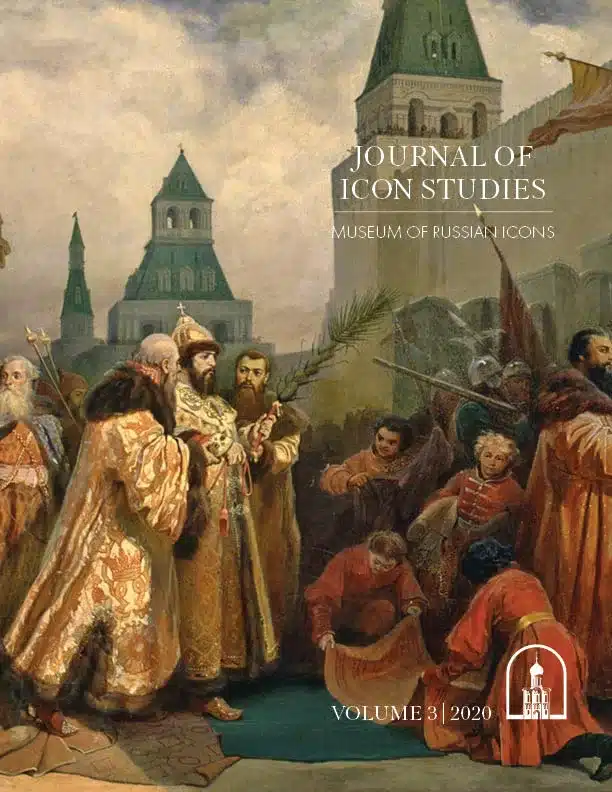
Journal of Icon Studies, Volume 3, 2020
Fittingly in this year of a global pandemic, the current issue opens with Kirstin Noreen’s examination of cult images in Rome during occurrences of disease and their association with miraculous healing and intercessory power. Mateusz J. Ferens explores the theological meaning and function of decorative-shaped text in Byzantine manuscripts and other media. Drawing on Alexei Lidov’s concept of the “spatial icon,” Kathleen Scollins reexamines the final chapters of Dostoevsky’s Crime and Punishment within the context of the Palm Sunday Donkey Walk ritual. Finally, Marcus C. Levitt analyzes two key pairs of scenes in War and Peace in which Tolstoy explicitly invokes Napoleonic visual images and undercuts them by juxtaposing them to Russian icons.
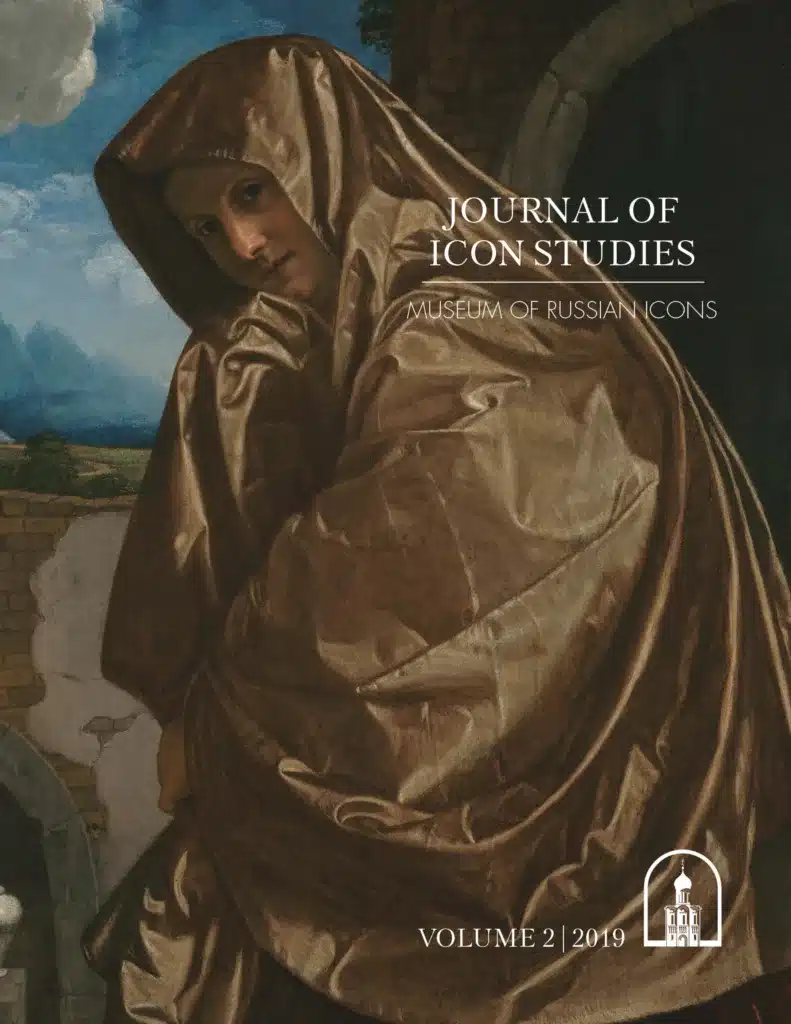
Journal of Icon Studies, Volume 2, 2019
The move to an online format has been inspired by the example of pioneering publications like the Journal of Historians of Netherlandish Art, Nineteenth-Century Art WorldWide, and British Art Studies. We are grateful to our authors for their willingness to publish original scholarship in this digital format. Their contributions demonstrate the exciting potential of icon studies as a sphere of interdisciplinary research. This issue explores the experiential function of Giovanni Girolamo Savoldo’s Magdalene paintings; the role of icons in the spiritual lives of the Chuvash; Leonid Chupiatov’s religious paintings during the Leningrad Seige; and the contemporary icons of Bulgarian painter Julia Stankova.
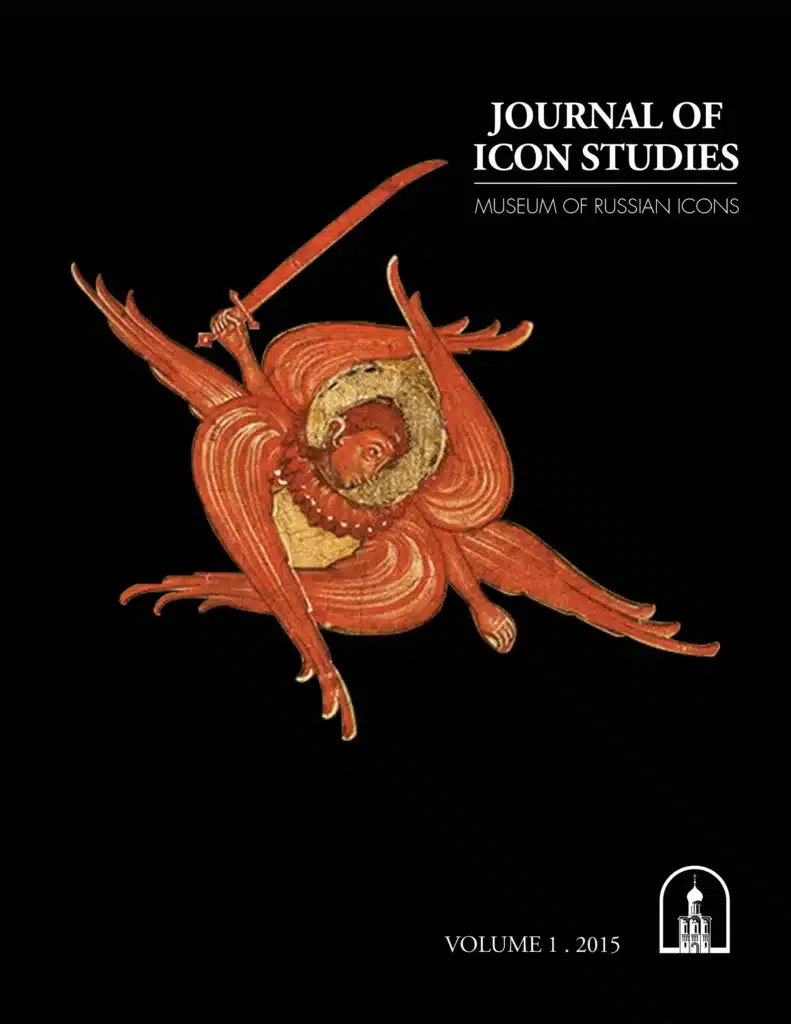
Journal of Icon Studies, Volume 1, 2015
The research presented here covers a variety of topics, from the analysis of specific iconographic elements in icons, such as identifying new elements in traditional icons, to a philosophical inquiry on the representation of the divine. Each contributing researcher has a different perspective and level of experience in the field, from Engelina Smirnova, the doyenne of iconographic studies in Russia, to Diana Dukhanova, a graduate student at Brown University.
OPEN ACCESS
Journal of Icon Studies (JIS) is an open-access publication and adheres to the Budapest Open Access Initiative (BOAI) definition of open access. This means that users may “read, download, copy, distribute, print, search, or link to the full texts” of its articles. JIS does not charge readers or institutions for access to the Journal. All content published in JIS is freely available immediately following publication (there is no embargo period).
AUTHOR’S RIGHTS
Authors retain the copyright of the content they publish with JIS with no restrictions. They allow JIS to distribute and continue to make available the article in perpetuity under the Journal’s preferred license (Creative Commons CC BY International 4.0 license). After publication in JIS, authors are free to republish their material elsewhere, providing an acknowledgment that the article or review was first published in JIS is made.
COPYRIGHT
All articles and reviews in JIS are published under the Creative Commons Attribution 4.0 International Public License (CC BY 4.0) unless otherwise noted. All images are reproduced with the permission of the rights holders acknowledged in captions or are reproduced under license and are expressly excluded from the CC BY 4.0 license covering the rest of this publication. These images may not be reproduced, copied, transmitted, or manipulated without consent from the owners, who reserve all rights, and outside the terms of any specified license. It is the responsibility of the author to cite the relevant copyright when using images and other digital materials.
CITATIONS
Journal of Icons Studies is a digital publication intended to be experienced online and referenced digitally. PDFs are provided for ease of reading offline. Please do not reference the PDF in academic citations: we recommend using DOIs (digital object identifiers) provided within the online article. These unique alphanumeric strings identify content and provide a persistent link to a location on the internet. A DOI is guaranteed never to change, so you can use it to link permanently to electronic documents. We ask users to identify the use of materials made available through this website and to provide appropriate credit to the author and the publication so that others may find and use our resources. The Journal is made available free of charge.
PUBLICATION GUIDELINES
Contributions to the Journal of Icon Studies are solicited in all areas of icon research. Submissions and any questions should be sent by email to the Editor, Wendy Salmond, at research(at)iconmuseum.org.
The Journal of Icon Studies follows the editing practices of The Chicago Manual of Style, 16th ed. (Chicago: University of Chicago Press, 2010). Refer to Webster’s Third New International Dictionary or Webster’s Fourth for spelling. For transliteration from Russian to English, please use the Library of Congress transliteration system.
All submissions must be sent electronically via email or large-file transfer service such as YouSendIt.com. The Journal of Icon Studies does not accept hard-copy submissions.
SUBMISSION CHECKLIST
Submissions are currently paused.
The manuscript in Microsoft Word, all elements of which must be double spaced (including endnotes and numbered captions) with a maximum of 16,000 words, including endnotes. Please do not send PDFs since these files cannot be altered to preserve anonymity during blind peer-editing;
An illustration list in Microsoft Word, also double spaced, with a maximum of 20 images; A Microsoft Word file no larger than 10 MB containing all illustrations. If the file is larger than 10 MB, the JIS cannot send it to peer reviewers since many institutional firewalls block files larger than 10 MB.
Submissions should include a cover sheet with the author’s name, a 50-word biographical statement (double spaced), and the manuscript’s total word count, including all text and notes. The author’s name should appear only on a separate cover sheet. In addition, the title of the article, but not the author’s name, should be repeated on the first page of the text.
A 100-word abstract of the article with a list of keywords
PEER REVIEW
All submitted articles are given an initial review by the Editor of the Journal of Icon Studies. This initial evaluation is guided by the following criteria:
- The material is original and important.
- The writing is grammatically correct and clear.
- The data are appropriate to the topic and factually accurate.
- The conclusions are reasonable and clearly supported by the data.
- The topic has general interest to the icon research community.
The Editor assesses the paper’s initial eligibility for publication based on these criteria. Manuscripts not satisfying these criteria are rejected, and a notice sent to the author. If the manuscript satisfies most of these criteria, it is sent to three members of the Editorial Board with knowledge of the submission topic. They may, in turn, submit it to outside reviewers. The identity of the specific reviewers is kept confidential from the author(s), just as author identities are kept confidential from the reviewers. Reviewers must maintain confidentiality about the manuscripts they review and must not divulge any information about a specific manuscript or its contents to anyone not involved in the review process.
EDITING
If the manuscript is accepted, the author is notified, and the publication process is begun. The manuscript is returned to the author for revision with reviewer comments if it is accepted with revisions. Authors are responsible for all statements made in their work, including changes made during editing. The final form rests in the hands of the Editor of the Journal after consultation with the author and reviewers.
PUBLICATIONS ETHICS STATEMENT
The Journal of Icon Studies expects its editors, authors, and reviewers to commit to and respect the following principles.
- The work submitted for publication in JIS is original;
- The work has not been previously published (unless it is a translation published in accordance with the Journal’s mission to serve as a bridge between different national and academic milieus and is referenced as such);
- The authors will refrain from submitting the work for publication elsewhere while JIS reviews it and following a positive outcome of the review process;
- All sources in the manuscript are properly cited and referenced in accordance with JIS style;
- The editor of JIS will evaluate submitted manuscripts solely on their intellectual merits and the extent to which they foster JIS’s mission;
- The editor of JIS will maintain strict confidentiality in all matters pertaining to the publication of the manuscript;
- Each reviewer will evaluate the submitted manuscript solely based on criteria outlined in the Journal’s peer review form;
- Each reviewer will notify the editor of any potential conflicts of interest;
- Each reviewer will maintain strict confidentiality in matters pertaining to the review process;
- Each reviewer will notify the editor of any potential reason to reject the manuscript.