
Journal of Icon Studies, Volume 4 | Fall 2025
From Forges to Fiery Furnaces:
Amy Putnam, Russian Icon Collector
by Derrick R. Cartwright

The Timken Museum of Art is renowned for its collection of European and American paintings. The museum also possesses a group of Russian icons dating from the 15th to 19th centuries. While numerous, these icons are somewhat less well celebrated. The devotional images have been shown in a dedicated space since the museum first opened in 1965. The icons represent the personal collecting passion of one of the museum’s founders: Amy Putnam. With her two sisters, Anne and Irene, Putnam relocated to San Diego, California, in 1913 from the family home in Bennington, Vermont. She later studied Russian language and literature at Stanford University. After becoming enamored of Russian culture, and after inheriting the family fortune, in 1938 Putnam’s personal collecting interests expanded beyond the “Old Masters” that she frequently donated to museums. At the time of her death, Putnam owned more than 300 Russian icons. These were kept in her private rooms within the mansion that she and her older sister, Anne, shared at Fourth and Walnut Streets in San Diego’s prosperous Banker’s Hill neighborhood. This paper speculates about the goals behind Putnam’s drive to surround herself with these remarkable works.
Derrick R. Cartwright is Associate Professor of Art History at the University of San Diego and Director of Curatorial Affairs at the Timken Museum of Art. A scholar of modern American art and architecture, Cartwright lectures and publishes regularly on topics ranging from transatlantic exchange, to photography, public art controversies, and collecting.
Recommended Citation: Derrick R. Cartwright, “From Forges to Fiery Furnaces: Amy Putnam, Russian Icon Collector,” Journal of Icon Studies 4, 2025
The text of this work is licensed under a Creative Commons Attribution 4.0 International License (CC BY 4.0). All images are reproduced with the permission of the rights holders acknowledged in captions, or are reproduced under license, and are expressly excluded from the CC BY license covering the rest of this publication. These images may not be reproduced, copied, transmitted, or manipulated without consent from the owners, who reserve all rights, and outside the terms of any specified license.

Timken Museum, Fiery Furnace, art collecting, Russian icons, Amy Putnam, philanthropy, San Diego, museum founders.
My employer has about 350 icons, some of which are peeling and need attention . . . I know it is a great distance out here [but] perhaps we could get your advice on what to do about these icons and . . . we could make it attractive enough for you to come out and work on them.[1]
Reasonable people reading a quote like the one in this epigraph might react: “that’s not a promising start to assessing any great collection of Russian icons.” Hundreds of devotional objects in dire condition, consigned to the hinterlands, sounds dismaying. My contention in what follows is that a certain incredulity, and some wonder, necessarily surround ambitious collecting enterprises in peripheral contexts. These qualities are signaled in the above letter by the writer’s repeated regret for being “out here,” as well as by the plea to just “come out” with the promise of making the venture “attractive enough” for the recipient to perform urgent services. Such an assignment cannot help but sound more like punishment than sweet reward when framed in these terms. In this case, however, we are talking about Southern California in the mid-twentieth century, a place that might have seemed remote to some at the time, but which was well on its way to becoming a major cultural destination. The motivations informing private collecting habits ought to be interrogated in light of their unlikely conditions, even—or especially—when they appear to border on undisciplined mania.[2] What follows might be interpreted as an investigation, and hopeful reconsideration, of such tough judgments.
The quote that opens this paper is extracted from a slightly longer letter destined for Jere Abbott. Abbott was formerly the Director of the Smith College Museum of Art in Northampton, Massachusetts. Before that, he served as Associate Director of the Museum of Modern Art in New York City. By the time this slightly desperate correspondence reached Abbott he was living in Manhattan, mostly retired from the art world but evidently considered a candidate for part-time duties as an art restorer, or at the very least an expert who might provide some profitable help with Russian art. Except for accompanying Alfred H. Barr, Jr. on a visit to Moscow early in his MoMA days, Abbott possessed only passing interest in icons, a fact amply revealed by a listing of the museum publications he wrote, the vast majority of which were devoted to canonical Modernist painters.[3] He explained as much in his curt reply to Frederick S. Parker, the letter’s author.[4] For his part, Parker should not be faulted for trying. He was not trained as an art scholar; he was hardly even a qualified amateur. Rather, his connection to the Putnam sisters stemmed from his role as former vice president of Guaranty Trust Bank in New York, as well as the president of a recently-formed legal entity in San Diego called the Putnam Foundation. That non-profit was the brainchild of a San Diego attorney named Walter Ames, created on behalf of two of his wealthiest clients, Amy and Anne Putnam. Amy Putnam [fig. 1] was the “employer”/collector invoked in the letter. Together with her sister, Anne, she had earned a reputation as a generous, and serious, art lover in her adopted city. Their middle sibling, Irene, passed away in 1935 and was not directly involved in the growing prestige of their art collections. Indeed, the two Putnam sisters still rank high among the most generous philanthropists that the city has ever seen, acting as primary benefactors for European art collections first at the San Diego Fine Arts Gallery (now the San Diego Museum of Art) and, slightly later, at the Timken Art Gallery (now the Timken Museum of Art).

(Timken Museum of Art Archives).
Parker’s effort to engage Abbott, though failed, is noteworthy for at least two reasons: it provided an estimate of the number of Russian icons that Amy Putnam had in her possession by the early 1950s, and it conveyed a candid assessment of their condition which was, generally speaking, not especially good. The sheer number of icons compares favorably with other contemporaneous private icon collections, such as the George Hann Collection which was first published around the same time.[5] The San Diego icons’ poor state, while regrettable, was concerning to their then 79-year-old owner, a care that is emblematic of her stewardship. When Parker finally identified someone to assist with the conservation of his client’s still-growing collection, that professional was found in the nearby beach community of La Jolla. Frank N. Dorland, Jr. received the job. Starting in Spring 1953, Dorland dedicated the next four-and-a-half years to “restoring” the icons and other Russian objects collected by Putnam. His invoices reveal that he habitually spent between three and eighteen hours on each object, for which he received an hourly rate of $3, not including associated costs [fig. 2]. A typical description of the work performed can be found on a conservation bill dated May 24, 1954:
Large golden icon, dirty with overpaint over bad varnishes and corrosion, clean to original, poly coat & wax face & reverse. 12 hours.[6]

La Jolla, California, May 24, 1954,The Dorland Company File,
(Timken Museum of Art Archives).

Independent Journal (Marin County), 18 Nov. 1973, page 1.
Working quickly and reliably, Dorland became a trusted confidant. He sourced works for Putnam and occasionally performed icon-scouting missions on his own, traveling to Los Angeles or Santa Barbara in search of quality works rumored to be up the coast. Somewhat later, and not without notoriety, he became the custodian of valuable Orthodox works such as the so-called “Our Lady of Kazan” icon which he safeguarded on behalf of its English owners before it was put on display at the New York World’s Fair, in 1964.[7] [fig. 3] For her part, Amy herself reviewed and paid no fewer than 57 of Dorland’s invoices. These arrived in her mailbox with machine-like regularity, often multiple times per month. The last bills arrived in February of 1958, a few months before the collector’s death. Beyond providing a glimpse into the more or less systematic approach the owner took when it came to preserving these objects, the conservation records provide insights into the icons’ configuration within the Putnam household: in addition to being marked “paid” in Amy’s looping cursive penmanship, Dorland’s bills were also annotated with locations: “10 icons from the library,” and so on.
This sprawling domestic collection grew alongside, but was distinct from, the “old masters” that for almost two decades Amy and Anne busied themselves acquiring for West Coast museums on a mostly anonymous basis. The impulse to purchase important collections can be associated with the sisters’ expressed goals of strengthening Southern California culture, while their insistence upon donating without fanfare might be seen as a reflection of their modest, New England roots. In any case, the often-expensive paintings they sponsored at the request of local museum directors, like Reginald Poland at the Fine Arts Gallery, were almost never displayed in their home, even for brief periods of time. Instead, by the early 1950s, the Putnams donated outright a steady stream of works by Giotto, Giorgione, El Greco, Francisco de Goya, and dozens of other painters, which were shipped directly to San Diego’s main museum. They also donated works by Adriaen van Ostade and Alessandro Magnasco to the Los Angeles County Museum of Art where the director, Wilhelm (William) R. Valentiner, served as another occasional adviser. While oil paintings by Pieter Brueghel the Elder, Rembrandt van Rijn, Jacques-Louis David, among others, were discretely purchased and immediately placed on loan to major museums–such as the National Gallery of Art, the Fogg Art Museum at Harvard, Metropolitan Museum of Art—far from their legal owners’ residence, those acquisitions were merely awaiting the construction of a new, independent, Putnam-financed gallery in San Diego. The Timken Museum of Art, a modernist cube, did not yet exist except as whispered dreams between Amy, Anne, and their attorney, Ames. Meanwhile, icons proliferated throughout private rooms of the mansion that the sisters shared at 328 Walnut Street in San Diego’s Banker’s Hill neighborhood [fig. 4].

San Diego, California (Timken Museum of Art Archives).
Outside of the Putnam family, only a select few individuals ever experienced the inside of that stately but wholly private residence.[8] Exaggerated descriptions of the interior’s general disorder exist in scattered accounts. For example, a former employee of the sisters later described the house as being “dark, crepuscular, and gloomy.”[9] Few photographs of the living spaces have survived to the present, but one undated image shows an orderly, if somewhat tightly grouped, display of more than 40 icons in what may have been one of Amy Putnam’s personal living spaces [fig. 5]. The icons were consigned to an uncertain future after Amy’s death. When Anne—the only surviving Putnam in California who was largely incapacitated during her last decade—died four years later, fewer than a dozen people (most of them longtime employees) attended the 94-year old’s funeral. This is itself, perhaps, surprising since the memorial service was announced prominently in San Diego’s main newspaper in an article that valorized both sisters as prominent patrons of numerous local cultural and charitable organizations.[10] Today, it would be hard to minimize the Putnams’ lasting public impact, even if their private lives went mostly unwitnessed, and uncelebrated, especially at the end.

San Diego?, c. 1950 (Timken Museum of Art Archives).
By the mid-1950s, Parker estimated that the sisters’ spending on works of art destined for museums alone—hence, not including the icons—had been not less than $2 million.[11] (Adjusted for inflation that equates to about $20 million today.) As their highly-involved banker, Parker was in a position to know. He once boasted to an assembled group that the Putnams would ultimately be judged as having created the finest art collection west of the Mississippi. Setting aside the question of whether Parker was overstating the case, let’s consider what is left out of the public assessments of these women’s collecting efforts, for which help from Abbott, Dorland, and others was sought: the Russian icons.
Amy Putnam loved
the icons dearly and kept them close during her somewhat isolated, final years.
Existing records are scattered and likely incomplete. A notebook written in
Amy’s hand kept at the Timken Museum of Art records no fewer than 339
individual purchases of Russian artworks. Beginning in 1942, these acquisitions
included paintings, drawings, and prints, all of which she would continue to
collect until at least 1957.[12]
Coinciding with this period, Putnam also acquired a significant research
library of books about Russian art, especially icons, from Brentano’s Bookstore
in New York City.[13]
Together with books on Russian church architecture and history, these records
survive as ample proof of the breadth, and depth, of her personal collecting
passions. While accounts suggest that Amy took time to burn a large part of her
personal correspondence in the last months of her life, from the few letters
that survive, we can surmise that icon-collecting consumed a large part of her
daily thoughts. These documents—including a text written in Cyrillic
script—reveal no signs of conventional religiosity on her part. Neither Amy nor
her sisters were practitioners of Orthodox faith. This curious fact marks her
collecting impulse as different from, say, the ideas that motivated other great
icon collectors of the twentieth century, such as Dominique de Menil, whose
religious conviction indisputably played a role in her accumulation of
Byzantine representations.[14]
If these works were not destined for worship or aesthetic appreciation by the
public during her lifetime, we should ask how one might make sense of these
objects in relation to Putnam’s other, more visible art collecting pursuits.
Before turning to that question, some brief background about how the Putnam sisters ended up in San Diego is necessary. The women traced their roots back to the Revolutionary War era on both sides of their family. New York’s Essex County, deep in the Adirondacks, was a hub of their forebears’ settlement, a fact I will have reason to return to in my conclusion. Thetis Bishop, their mother, was a formidable matriarch. [fig. 6] She took pride in her role as a duly elected member of the Colonial Dames in Connecticut and as one of the Daughters of the American Revolution, a status which she aspired to pass on to her own three children. Bishop married Elbert Putnam in 1866. Elbert had an older brother named Henry with whom he went into business. The two men created a significant fortune together before moving to Bennington, Vermont. Time has judged Henry the more successful of the two brothers. He participated in the California Gold Rush as a young man and became a relentless inventor of gadgets: bottle caps, roofing nails, indoor washing machines, and other items. Henry’s philanthropic instincts also established the model for his relatives’ later exceptional generosity. Indeed, profits from Putnam’s many patents paid for a local hospital, opera house, public water system, library, and the largest commercial office block anchoring a public square that still bears the family name in central Bennington. Not unlike legendary philanthropists Henry Huntington and Ellen Browning Scripps before him, in 1899, Henry booked an exploratory trip to California in search of better climate.[15] He traveled to San Diego with his two youngest nieces—Amy and Irene—and afterwards purchased parcels of land along Fourth Avenue, announcing plans to build a grand home for himself overlooking the Pacific Ocean. Elbert followed his brother to California in early 1913. In April, he purchased two lots for himself with the expressed goal of setting up his own household a few blocks away from his brother. When Henry died in 1915, Elbert ably managed his share of the family resources until his own death in 1927. Shortly thereafter, Henry’s only son and his primary heir, Will Putnam, passed away in Florida. In 1936, he left his bright, independent, female cousins an estate valued at more than $5 million in the midst of the Great Depression, roughly the equivalent of $95 million today.
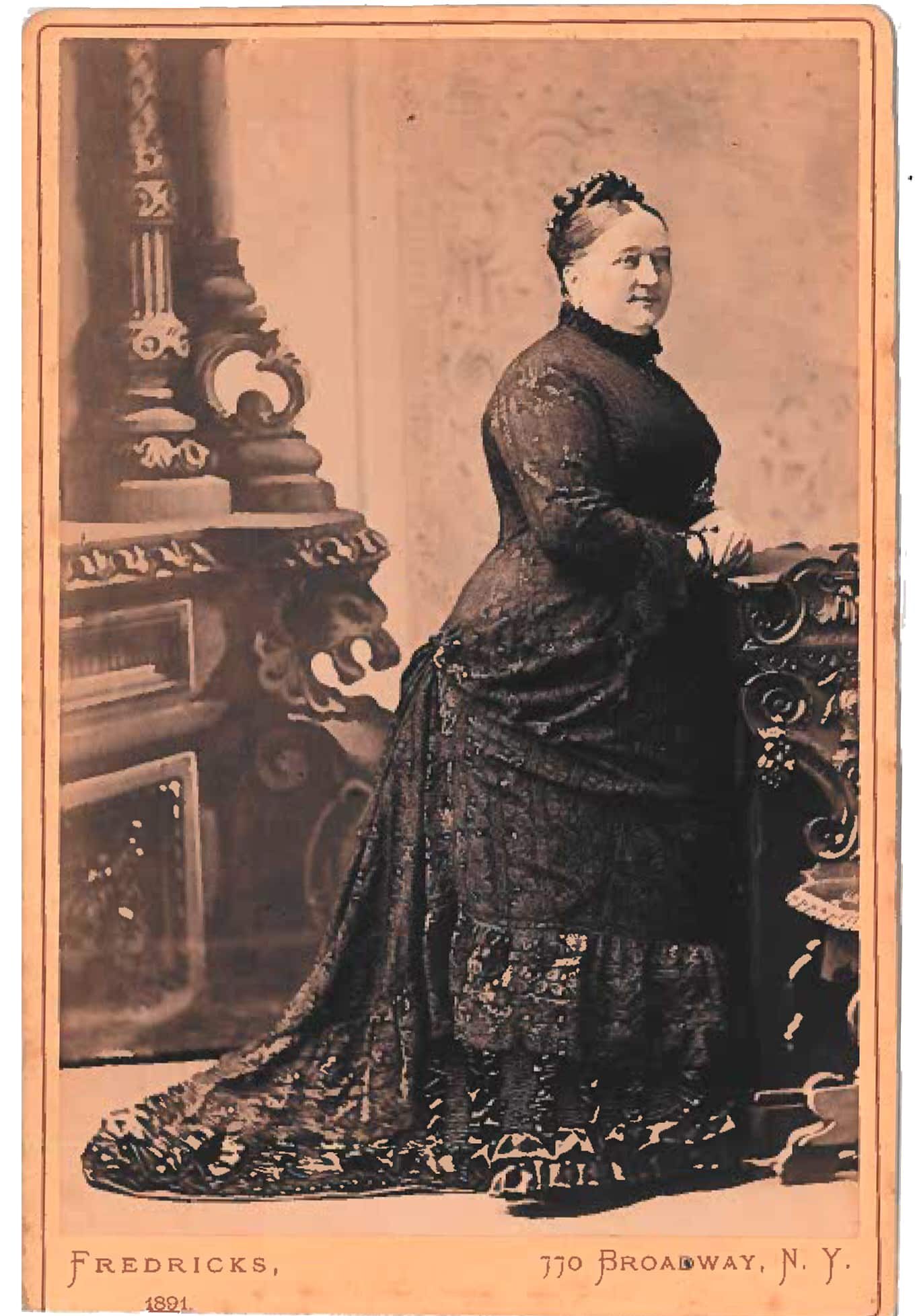
c. after 1875 (Timken Museum of Art Archives).
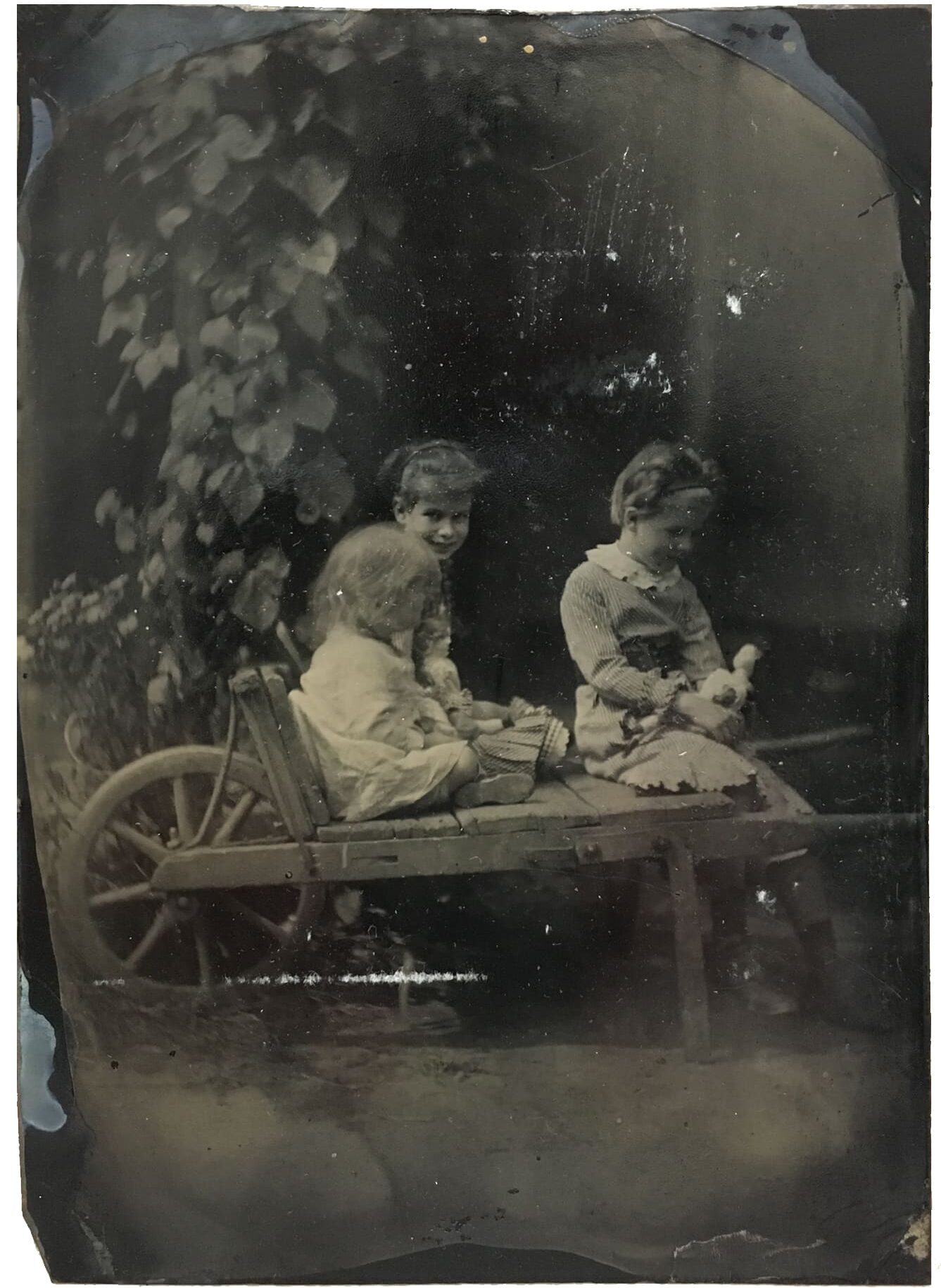
c. 1880 (Timken Museum of Art Archives).
A tintype photograph shows the three young daughters of Elbert and Thetis Putnam in Vermont, playing with dolls in the open air [fig. 7]. Some fifty years on, by the time they came into their fortune, they were three middle-aged, well-educated, and culturally savvy women who ultimately spent most of their time indoors. They were all single. Irene, who had studied at Smith College and published her own poetry, died relatively young, in 1935. Anne was the oldest and lived the longest of the three, although she was bedridden for much of the last decade of her life. She spoke fluent French, read Latin, and was well informed about contemporary politics and literature. She was Amy’s partner in the majority of decisions they made about collecting historical European art. Amy was perhaps the most intellectual, and most independent of the three women. One of roughly 140 “co-eds” admitted to Stanford University in 1926, she studied Russian literature beginning in the summer session. Amy’s arrival in Palo Alto seems to have coincided with the appointment of a charismatic, if perhaps morally suspect professor of Russian by the name of Henry Lanz.[16] It seems possible that Putnam took her first courses in the fledgling Slavic language program that Lanz founded. Putnam learned to read and write in Russian while at Stanford. Letters, newspaper clippings, and the library she amassed demonstrate that she kept up her language skills for the rest of her life—in other words, another 32 years. Shortly after completing her course of study, Amy traveled extensively, visiting England, France, and Switzerland between April 1928 and July 1929. She went abroad again less than a year later, this time visiting Italy, Prague, Warsaw, and other Eastern European capitals. In extensive journals that record these experiences, she comes across as a curious, unhesitant, and tireless tourist.[17] It is somewhat surprising that she did not consider crossing into Russia on this extended sojourn since she possessed fluency in the language.[18] Nonetheless, her interest in Russian culture continued to evolve over the next three decades, the majority of which she spent closer to home, in San Diego.
In addition to the books she acquired, other archival documents at the Timken Museum of Art further underscore Amy’s interest in Russian culture following her intensive language study. She became a devotee of Russian dance and music while reading Tolstoy without the distraction of translation.[19] As noted above, she purchased numerous Russian paintings, not all of which were icons. These included a large-scale portrait of the Countess Samoilova by the historical painter, Karl Bryullov, [fig. 8][20] and multiple works by the late-nineteenth century realist, Ilya Repin, as well as watercolors and heroic sculptures by a number of Repin’s Russian-speaking contemporaries. Indeed, Putnam knew Repin’s oeuvre well enough to identify the pictorial source for an untitled drawing she received as a gift from an advisor.[21] While her collecting spree began in the mid-1930s, roughly coinciding with the moment she gained access to her inheritance, Putnam never collected work by any vanguard Russian artists of the Revolutionary period although it seems likely that she knew about them. The fullest proof of her growing fascination with icons appears a half-decade later in a key letter.

c. 1832, photograph in the Timken Museum of Art Archives
(Hillwood Estate, Museum and Gardens, Washington, DC).

17th c. (Putnam Foundation, Timken Museum of Art, 1963.004).
The date of this correspondence, early 1942, is significant because it memorializes a visit to the Putnams’ house by an art dealer, Jacob Heimann. Heimann would go on to sell the sisters dozens of Old Master paintings which they subsequently donated to museums.[22] Having been granted rare access to the interior of the Putnams’ Mediterranean-style villa, Heimann sent an excited and detailed report about what he had seen to his “cousin,” Leon Grinberg. Grinberg, together with Jacques Zolotnitzky, ran A La Vieille Russie, Inc., the artfully-staged shop dealing in Imperial Russian luxury items and antiques on Manhattan’s Upper East Side. In April of 1942, Grinberg hardly needed urging from Heimann to begin actively soliciting Putnam. Acknowledging that she already possessed a sizable collection of Russian icons, he wrote to her, “Am I to understand that you have about 300 such?” He then went on to wonder if his “modest knowledge in this field can ever be of help to you?”[23] For the next 15 years, Amy Putnam acquired multiple Russian icons from the deep inventory of A la Vieille Russie, including major works such as Our Lady of Jerusalem, for which, after extensive negotiations, she paid $3,500 in 1956.[24] [fig. 9]
The acquisition of larger icons, such as Our Lady of Jerusalem, marked the acceleration of Amy Putnam’s collecting, a period that would peak in the mid 1950s. It is clear from her correspondence with a variety of dealers from this time that Putnam was not only pleased with her success at having obtained a few major devotional works, but that she was intent upon collecting other imposing icons which would eventually find their home in a museum context. Central to this pursuit was the acquisition of an authentic iconostasis ensemble. The lower register of an iconostasis might logically include a central image, such as the Mother of God, with Mary directing attention toward the seated Christ child in the manner of the traditional Hodigitria (She who Shows the Way). Securing such an image was a priority for the collector as she ably negotiated with dealers. Reading through her correspondence from this time, one observes Putnam’s motivations becoming increasingly competitive, driven by the need to secure works in a marketplace that she perceived to be inflected by scarcity as well as by rival collecting interests. The loftier prices that Putnam paid for her later acquisitions stand in contrast to the costs of many of the earlier Russian works that she bought, most of which were small in scale and were intended for personal, domestic display only. Putnam’s focus on making the Russian icons a substantial part of her museum-building enterprise ultimately came to resemble her pursuit of old master works by Peter Paul Rubens, Paolo Veronese, and others, for which multiple big city museum directors vied for consideration as final recipients.[25] In early 1957, Putnam was offered a set of Deesis icons from a large iconostasis for a price of $8,000, which represented the single most significant purchase of Russian Orthodox images to date in her sprawling collection. Although she lived for only little more than a year after making the decision to acquire the work, the rare iconostasis, one that “would greatly enhance [her] already important icon collection,” marked a culmination of sorts in this decades-long collecting effort.[26]

c. 1965 (Timken Museum of Art).
It is difficult to say exactly what happened to the 350 or so devotional objects that were in Amy Putnam’s home at the time of her death. Sixty-eight of Putnam’s icons were formally accessioned into the Timken’s permanent collection when the sisters’ estate finally settled in 1963. Plans for a free museum funded by the Putnam Foundation had gathered unstoppable momentum by that time. Russian works were destined to play a role, albeit not the lead one, in the project. Nevertheless, since the museum opened its doors in 1965, a group of icons has been displayed at the Timken, more or less without interruption. A dedicated gallery decorated with custom-made, Italian, flocked, green wallpaper, said to have been chosen by Amy herself, was outfitted for this purpose [fig. 10]. At least 130 Russian objects, including many icons, were soon after shipped in batches to various galleries and dealers in New York. From 1966 until the early 1970s these were sold intermittently. The documentation surrounding these sales is spotty which, while regrettable, evidently reflected the attitude of the museum’s stewards at the time. According to Walter Ames, who became the first director of the Timken upon its opening, the icons were imagined to be “of little value.” Ames went on to tell vendors that “doubtless you can find some way of disposing of them.” A large number of the Putnam icons were shipped back to their commercial source, A La Vieille Russie, under long-term consignment agreements with the gallery.[27] Some, but not all, were sold to private collections. Another 14 icons were deaccessioned formally and sent to Sotheby’s for auction in June, 1980.
In 1967, a prospective icon buyer inquired about provenance information related to the California collector of these works of art. In response to this request Ames offered the following sentences:
Miss Amy Putnam was born in New York State on May 27th, 1874 and died in San Diego on July 23rd, 1958. . . As a young lady she went to Palo Alto and took special instruction in Russian literature under a Russian Professor at Stanford. She had limited ability to speak the language and read it with ease. This resulted in her interest in Russian culture prior to the Revolution. She was entirely out of sympathy with communism and all it represented.
In addition to getting Amy’s birthplace wrong,[28] Ames’s truncated biography misses a lot. This is surprising since for several decades he interacted on an almost daily basis with her, arguably his most important client. His letter seems especially keen to emphasize the patriotic motivations surrounding this collection, something that begs to be understood in light of Cold War attitudes. We might surmise, however, that this brief portrait of Amy represents Ames’s worldview more accurately than it portrays hers.[29] In any case, the assertion that Amy’s outsized interest in Russian things derived solely from her Stanford experience merits additional scrutiny.
As unmarried, wealthy women of advancing age, living far from their Eastern roots, the sisters often received letters from distant “relatives” and other associates seeking news about their health and expressing interest in receiving “mementoes” (preferably in the form of bequests). Coming from unacknowledged, or at the very least, forgotten members of the family, those letters mostly went unanswered. At least one of these received a response, and I want to turn to it as a form of conclusion, since it provides a clue to the icons’ personal allure.

(Timken Museum of Art).
In the correspondence in question, a Putnam cousin asks innocently if Amy and Anne still possess a picture of the “family forge” and hopes that it brings them joy. The passing comment can be connected to a small, unsigned, and unframed painting that has presented a puzzle ever since it was encountered in the Timken Museum’s object storage area in 2016 [fig. 11]. Further research has since clinched the image’s association with published descriptions of “a forge managed by Messers Elbert and Henry Putnam containing four fires and a wooden hammer of about 1800 pounds.” The name of said enterprise is The New Russia Forge. New Russia is a place of tremendous significance to the Putnam family. It appears often on birth certificates and deeds to property. Elbert Putnam made a claim related to the discovery of gold in New Russia, and title documents show that Thetis Putnam transferred property she still owned in New Russia to her daughters as late as 1916, that is, several years after the sisters had relocated to San Diego. The diminutive picture—about the size of a personal icon—must have been one of the artworks that the Putnams brought with them from Vermont to California, which Dorland dutifully cleaned and restored for Amy Putnam in March 1955, together with portraits of several ancestors, before rehanging all of them on walls in her house.
New research suggests that this modest painting is likely the work of Bainbridge Bishop, Thetis’s brother, who was an artist of some reputation and who may have conceived the work as a companion piece to another interior depiction of his two sisters—Thetis and Amy—weaving blankets as part of an effort to support Union troops during the Civil War.[30] While he was recognized during his lifetime as a painter and photographer of some talent, Bishop is best known today for his invention of the “color organ,” a device that used a keyboard to translate acoustic pitches into beams of projected light, which he patented in 1877.[31] This small genre scene was, in short, freighted with familial and geographic importance for the Putnam women.

(Timken Museum of Art Archives).
Any speculation about Amy’s lifelong identification with Russia, whether new or old, should be plotted alongside Ames’s limited explanation of Amy’s cultural attraction to that place. Still, I am reminded of several tintype photographs, dating to around 1890, found among the family papers; they show the three Putnam sisters gazing at the landscape beyond Bennington [fig. 12]. Even then, the women surely understood that the source of their prosperity was to be found not in Bennington but in nearby Essex County, New York. New Russia, in other words, occupied an enduring place in their imaginations, and the town provided accompanying senses of identity and self-worth. We can posit that the entrepreneurial fires that the Putnam brothers once stoked in New Russia continued to warm the Putnam sisters’ prosperous home in California, along with their audacious dreams of museum founding.
Perhaps nowhere is this suggestion expressed more clearly than in the icons themselves, where forge imagery kept special resonance. Take for example, a two-sided tabletka, a work subsequently acquired by the Timken Museum of Art [fig. 13]. This small devotional object depicts twin, opposing miracles: one by fire the other by cold. One face of the wafer-thin tabletka depicts a scene from the Book of Daniel, which is often referred to as three Hebrew boys in a fiery furnace. The religious narrative tells us that Nebuchadnezzar, influenced by faithless advisors, sentenced the three righteous youths to punishment in a flaming pit, or furnace. Instead of perishing, however, they began to dance, and soon they were joined by another figure, alternately identified as the Lord or an angel. It is an image of transcendence, of hard-won independence, as well as of triumph over trials by fire. The same could be said of the modest genre painting by their uncle, a work that remained close to the Putnam sisters as they transitioned from schoolgirls to heiresses to influential philanthropists in their west coast community. A letter sent to Amy Putnam by the famed British-American adventurer, Frederick Albert Mitchell-Hedges in the year preceding her death signals how far she had traveled in her quest to forge her reputation as a globally recognized collector:
On one or two occasions in writing to me, Mr. Francis E. Fowler . . . has told me of your remarkable collection of Ikons which I believe is the finest in existence. . . I have just received a letter from Mr. Frank N. Dorland and knowing your Ikons, he has suggested to me that I send you a copy of last month’s issue of “Antique Dealer and Collector’s Guide” where you will see the illustration on the front cover of the “Black Virgin of Kazan,” the miracle icon of Russia. This is acknowledged to be the finest in the world and has been fully authenticated in every way.[32]

Furnace, 15th c. (Putnam Foundation, Timken Museum
of Art, 1979.001).
By 1957, Amy Putnam was accustomed to receiving such acknowledgments and associated offers to acquire new works of art. She had succeeded in creating a collection of icons that was judged, at least by some, among the best in private hands, and was thought to be without peer on the West Coast. At the same time, the sheer quantity of works that surrounded her in her private space had become a burden of sorts. The answer to the question “why so many icons?” remains an enduring puzzle, a compulsion without any clear explanation. By exploring possible motivations, however, we can begin to appreciate why Amy Putnam kept at least two kinds of meaningful representations close to her in Southern California: family snapshots that recollected her youth, and the devotional icons that framed her present. While conspicuously different, both categories of image suggest an inspired, metonymic relation to identity, a Putnam legacy remade into something new and vitally Russian.
Acknowledgment
The author wishes to thank Wendy Salmond and Justin Willson for their editorial advice and encouragement throughout the process of writing this essay.
Notes
[1] Frederick S. Parker to Jere Abbott, typed copy of letter dated 9 Jan. 1953, Parker Correspondence, 1953–54 (file 3.4-1) Timken Museum of Art Archives. Parker sent similarly imploring letters to other scholars around this time. For example, a letter in the same archive, dated 16 March 1953 was addressed to Professor Eugen Neuhaus at UC Berkeley explained that Putnam owned “approximately 350 icons of various size [sic] from the little two by four to large ones that are three by four feet.” Neuhaus was, like Abbott, not a specialist in Russian art. He was an artist and self-trained art historian and did not accept the invitation to consult with Parker about these works.
[2] This paper does not go far in offering psychological explanations for collecting impulses, but for those interested in theoretical approaches to this topic, I recommend Jean Baudrillard, Le systéme des objets (Paris: Gallimard, 1968), especially the section entitled “A Marginal System: Collecting,” or Walter Benjamin, “Unpacking My Library: A Talk about Book Collecting,” in Walter Benjamin: Selected Writings, 1927-1934 (Cambridge: Harvard University Press, 1996), 486–93.
[3] Among his many publications, Abbott contributed essays to catalogues and journals devoted to Wilhelm Lehmbruck and Aristide Maillol (1930), Diego Rivera (1931), Henri Toulouse-Lautrec and Odilon Redon (1931), Giorgio de Chirico (1941), El Greco (1927), and The Smith College Museum of Art’s Italian drawing collection (1937), but not, so far as I can tell, Russian icons. Abbott’s travels with Alfred Barr, Jr. to Russia, mostly to study theatrical performances and view modern art, are recorded in his diary, usefully republished as “Russian Diary, 1927-28” in October 145 (Summer 2013): 135–223. On Friday, Jan. 13, Jan. 21, and Feb. 10, 1928, Abbott records visits to the “Museum of Iconography” which included about sixty traditional icons as well as to the “State Historical Museum” where he described works as “superb” (182, 196, 222).
[4] Abbott’s reply, dated 22 Jan. 1953, reads, in full: “Dear Mr. Parker, Your letter of January 9th reached me here. I have not been the Director of the Smith College Museum for some time. I regret to say I am not a technician. My interest in icons is of their artistic and stylistic side. I would suggest you the restorer at the San Diego Museum to look at their condition and suggest repairs. Sincerely, Jere Abbott.” Parker Correspondence, 1953–54 (file 3.4-1), Timken Museum of Art Archives. Abbott served as director of Smith College Museum of Art from 1932 to 1946.
[5] See Russian Icons: The Collection of George R. Hann (Columbus: The Columbus Museum of Art, 1945). The Hann Collection was later sold at Christie’s in 1980. The collection formed by Ambassador Joseph E. Davies and Marjorie Merriweather Post, now at the Hillwood Museum in Washington, D.C., is another example of ambitious Russian icon collecting from the late 1930s through the 1950s. See Wendy Salmond, Russian Icons at Hillwood (Washington, DC: Hillwood Museum, Estate and Gardens, 2006); Anna Ivannikova, “The Path of the Russian Icon to America,” blogpost, Museum of the Russian Icon (12 Dec. 2021): https://russianicon.com/the-path-of-the-russian-icon-to-america-the-collection-of-oleg-kushnirskiy/ .
[6] Invoice in the curatorial files of the Timken Museum of Art. See “Lyons-The Dorland Company, Restorers.” Such invoices addressed to Miss Amy Putnam from Dorland appeared usually twice a month starting in May 1953 and ending in September 1956. Dorland moved to Mill Valley in Northern California in the 1960s.
[7] Letter from Frank Dorland to A. J. Sutherland, 19 December 1963, requesting loans from the Putnam collection to the New York World’s Fair, Timken Curatorial Files, “Lyons-Dorland Company Restorers”. See also “Fairgoers Moved to Tears by Icon: Russian Orthodox Painting on Display in Chapel,” The New York Times, Sept. 4, 1964: 27.
[8] A fawning, yet likely exaggerated, account of the sisters’ lifestyle appears as a typescript to a talk delivered by Julie G. Andrews at the Wednesday Club on Nov. 2, 1966. In her talk about the Putnam home Andrews passingly mentions the icons several times but also notes specifically that the sisters often entertained “natives of old Russia” and that “Miss Amy’s [Russian] collection suggests that she had in mind the acquisition of all the works essential to the iconostasis, or icon screen, which separate the Sanctuary from the nave in the orthodox church” (p. 6). A copy of the typescript is in the Timken Curatorial Files.
[9] See J. Moore, “The Mystery of Timken Gallery’s Putnam Sisters,” San Diego Reader (31 Jan. 1985): https://www.sandiegoreader.com/news/1985/jan/31/mystery-putnam-sisters/ .
[10] See “Anne Putnam, 94, Funeral Today, Art Patron,” San Diego Union (20 March 1962): A-15. The funeral took place two days after Putnam’s death. Anne was interred next to her sisters and parents in a plot secured long before in Greenwood Memorial Park in San Diego.
[11] Typescript of “Talk before a group of 24 people at dinner at my house,” by Frederick Parker, dated 1 June 1956, Parker Papers (file 3.3), Timken Museum of Art Archives.
[12] Acquisitions were numbered, beginning with “1. St. Nicholas, XVI Century. . . Purchased by S&G Gump Co. [San Francisco] from a Collection in Constantinople” up to “339 Virgin of Jerusalem (Church icon)”. Religious icons represent the majority of works in this inventory, although other Russian works such as portraits and landscapes appear. Interestingly, the notebook also includes records of two Santos presumably purchased by Putnam near the very end of this period: “Virgin of Guadalupe/Our Lady of Guadalupe, purchased in N. Mexico and 2 Santa Rita.” Untitled notebook, Amy Putnam Papers, Timken Museum of Art Archives. We also know that Putnam continued to purchase Russian works of non-religious nature at least until 1956. An invoice from Wildenstein & Co. records the sale of an oil painting by Ilya Repin, Portrait of a Russian Peasant, 1889, on 3 March 1956. An undated inventory list that includes this particular work, along with 41 other Russian paintings and drawings (not icons) can be found in two files. See “3.11.2. Misc. Icon Papers, 1956–68,” and “3.11.4. Russian Paintings,” Timken Museum of Art Archives.
[13] Four pages of titles offered by Brentano’s appear on an invoice and were purchased by Putnam in early 1943. See “Putnam Personal Documents and Papers,” file 1.2, Timken Museum Archives.
[14] On the relationship between Menil’s collecting inspirations and her progressive Catholic sensibilities, see Pamela G. Smart, Sacred Modern: Faith, Activism, and Aesthetics in the Menil Collection (Austin: University of Texas Press, 2010), especially 135–38.
[15] Huntington’s first trip to Southern California from New York in 1892 took place before the Putnams’ arrival. He did not permanently settle in San Marino until 1903, however. Similarly, Ellen Browning Scripps came with her half-brother, E.W., from the Midwest to San Diego in 1896. For an insightful account of a formidable woman’s business and philanthropic life in turn-of-the-century San Diego, comparable in some ways to the Putnams, see Molly McClain, Ellen Browning Scripps: New Money and American Philanthropy (Lincoln: University of Nebraska Press, 2017).
[16] It has been suggested that Lanz served as the real-life model for Humbert Humbert, the fictional narrator in Vladimir Nabokov’s 1955 novel, Lolita. Elements of Lanz’s biography support the identification. See Cynthia Haven, “The Lolita Question,” Stanford Magazine (May/June 2006): https://stanfordmag.org/contents/the-lolita-question
[17] These travel dates are deduced from the stamps in two of Putnam’s passports. Those documents, together with four of her handwritten travel diaries are today preserved at the Timken Museum of Art. See “A Finding Aid to Amy Putnam’s Travel Diaries,” Timken Museum of Art Archives.
[18] Indeed, Putnam accurately translated letters written to her in Russian well into the 1950s.
[19] For instance, a file of Russian newspaper clippings discussing the life of Leo Tolstoy is preserved among Putnam’s papers. See “Leo Tolstoy Clippings, 1928–29” in “Putnam Personal Documents & Papers,” file 1.2, Timken Museum of Art Archives.
[20] That portrait was one of the most expensive Russian acquisitions made during Putnam’s final years. She purchased the painting in 1954 on the advice of Alfred M. Frankfurter, who served as an occasional art advisor to both sisters. Amy’s lawyer, Ames, resold the work after her death through A La Vielle Russie, in 1965. It was subsequently acquired by Marjorie Meriweather Post and given to the Hillwood Museum in Washington, DC, in 1973.
[21] Putnam was still demonstrating the breadth of her knowledge of things Russian late in late. Just two years before her death, she wrote: “Thank you for the pencil sketch by Repin. . . Repin’s drawings always interest me for he expresses so much in a few lines. . . These two heads are from his well-known picture, Za porozhian [The Reply of the Zaporozhian Cossacks, State Russian Museum, St. Petersburg] and are tribesmen.” Letter of Amy Putnam to Alfred Frankfurter, 5 May 1956, “Amy Putnam Letters,” Timken Museum Archives.
[22] On Heimann’s questionable advising role vis-à-vis the Putnams, see John Marciari, “The Donors, The Director, the Dealer: Acquiring Old Masters at the San Diego Museum of Art,” in Italian, Spanish & French Paintings before 1850 in the San Diego Museum of Art (San Diego: San Diego Museum of Art, 2015), 13–27.
[23] Letter dated 6 April 1942 from Grinberg to Amy Putnam in “A La Vielle Russie” Curatorial File, Timken Museum of Art.
[24] Alexander Schaffer of A La Vieille Russie wrote a letter to Amy, dated 28 January 1957, dealing with this acquisition. It reads, in part: “I am delighted to know that you are pleased with the Virgin of Jerusalem [sic]. It is, indeed, a wonderful icon. I am sending you, under separate cover, a book on icons which was recently published in Switzerland, in which there is illustrated opposite page 60, a remarkable iconostasis of the sixteenth-century, which we own. . . Icons of this importance and quality are no longer available, as the Bolsheviks will not let any icon out of Russia. I feel this icon would greatly enhance your already important icon collection and, in order to tempt you, I will give you a very low price of $8,000.” Amy Putnam Personal Correspondence file 1.1, Timken Museum of Art Archives.
[25] The fulfillment of this ambition roughly coincided with the opening of the Timken Art Gallery to the public, in 1965. Writing for the institution’s first handbook to its permanent collection, Agnes Mongan explained, “[The] remarkable collection of icons made by the Misses [sic] Putnam . . . will be catalogued later.” Indeed, a small, 8-page pamphlet dedicated to the Russian icons was soon authored by Dean McKenzie. See Putnam Foundation: Icon Collection (San Diego, The Timken Art Gallery, 1967).
[26] Letter from Alexander Schaffer [A la Vieille Russie] to Amy Putnam, 28 January 1957, Personal Correspondence, file 1.1, Timken Museum of Art Archives.
[27] Ames’ letter to Alexander Schaffer, 24 June 1966 describes “upwards of 200 icons in our unused gallery along with some 30–40 oil paintings attributed to Russian artists.” Ames went on to say, “I know that many of the icons are of small value. . . The names on the Russian paintings are for the most part unknown to us.” A total of 42 icons were consigned to A La Vieille Russie in September of 1966 for which the museum received a check for $2,750 on October 7 of that year. See the correspondence in “Misc. Icon Papers, 1955–68,” file 3.11.2, Timken Museum of Art Archives.
[28] Putnam’s passports, now kept in the archives at the Timken, record her birthplace as Bennington, Vermont.
[29] Typescript of a letter written by Walter Ames, in response to a letter from Alexander Schaffer, dated 24 Nov. 1967, ibid. Amy Putnam does not appear to have been as resolutely opposed to Soviet culture as Ames suggests in his correspondence with Schaffer. She made substantial annual donations to Soviet charities during the 1940s, lasting through the conclusion of WWII. Acknowledgement letters dated December 1942, 1943, and 1944, now in the Timken Museum of Art Archives, document $3000 cash gifts to the Red Cross as received by the Embassy of the USSR.
[30] A letter from Frederick Parker to the leadership of the Historical Museum in Ticonderoga New York written 3 December 1954 confirms this identification: “One other picture [belonging to the sisters] is the Old Putnam Forge, which was at New Russia, and there is quite a history connected with this forge, as it was active during the Civil War, and it is rumored, although without proof or knowledge from us, that it did manufacture the plates for ‘the Monitor’.” Frederick S. Parker Papers, Timken Museum of Art Archives.
[31] See Bainbridge Bishop, A Souvenir of the Color Organ with Some Suggestions in Regard to the Soul of the Rainbow and the Harmony of Light (New Russia, NY: The De Vinne Press, 1893).
[32] Letter from F. A. Mitchell-Hedges to Amy Putnam, August 22, 1957, Personal Correspondence, file 1.1, Timken Museum of Art Archives. Mitchell-Hedges has been described by some as the model for the fictional movie character, Indiana Jones, because of his pursuit of exotic artifacts. Frances Fowler, like Mitchell-Hedges, was also a collector of fine silver. The correspondence between Mitchell-Hedges and Putnam stands as evidence of her visible recognition among private collectors of note in the mid-twentieth century. Frank Dorland, Jr., who published extensively on Mitchell-Hedges’ “miraculous” artifacts, evidently played the connecting role in this correspondence.