
Journal of Icon Studies, Volume 4 | Fall 2025
Richard Hare’s Russian Icon Collection and the Persistent Lure of Byzantium in Anglo-Soviet Artistic Relations
by Louise Hardiman

This article concentrates on the activities of Richard Hare, whose interest in icons sheds new light on the history of British and western collecting of and scholarship on Russian art in the twentieth century. For British audiences, as elsewhere in the west, Russian icons, their historical origins, and cultural significance were little understood beyond specialist circles. But, for a few decades in the mid twentieth century, they gained new visibility in the British art world. Despite this, probably for political reasons, state-owned museums did not extend their holdings and the gap was filled by a private collector: Hare, this article argues, was the first British collector of icons in significant numbers. He is a valuable case study of a western collector of Russian art, but his particular attention to icons illustrates an important leitmotif in the under-researched picture of Anglo-Soviet artistic relations, namely, the persistence of Byzantinism in British responses to Russian art.
Louise Hardiman, Ph.D., is an independent art historian based in Guildford, U.K., whose career spans teaching, writing, and consultancy. Her current research projects examine women and the arts in imperial Russia, northern landscape painting, and the history of British-Russian cultural exchange; her recent teaching includes the development of new courses on Russian art and Ukrainian art for University of Cambridge Professional and Continuing Education.
Recommended Citation: Louise Hardiman, “Richard Hare’s Russian Icon Collection and the Persistent Lure of Byzantium in Anglo-Soviet Artistic Relations,” Journal of Icon Studies 4, 2025
The text of this work is licensed under a Creative Commons Attribution 4.0 International License (CC BY 4.0). All images are reproduced with the permission of the rights holders acknowledged in captions, or are reproduced under license, and are expressly excluded from the CC BY license covering the rest of this publication. These images may not be reproduced, copied, transmitted, or manipulated without consent from the owners, who reserve all rights, and outside the terms of any specified license.

Richard Hare, Russian Icons, Dorich House, Russian Studies, Soviet Union.
Museum collections of Russian icons in are rare in Britain, the three main examples being those of the British Museum, the Victoria and Albert Museum, and Dorich House Museum (part of Kingston University, London).[1] All are relatively small, but the latter is arguably the most historically significant, for it was formed in the mid-twentieth century as part of a larger collection of Russian art assembled by Richard Hare (1907–1966), a professor of Russian literature at the School of Slavonic and East European Studies, with support from his Latvian-born émigré wife, the sculptor Dora Gordine (formerly Gordin, 1895–1991) [fig. 1]. This article concentrates on the activities of Hare, whose interest in icons sheds new light on the history of British and Western collecting of and scholarship on Russian art in the twentieth century. For British audiences, as elsewhere in the West, the historical origins and cultural significance of Russian icons were little understood outside specialist circles. But, for a few decades in the mid twentieth century, they gained new visibility in the British art world. Despite this, probably for political reasons, state-owned museums did not extend their holdings, and the gap was filled by a private collector: Hare, this article argues, was the first significant British collector of icons. He is a valuable case study of a Western collector of Russian art, but his particular attention to icons illustrates an important leitmotif in the under-researched picture of Anglo-Soviet artistic relations, namely, the persistence of Byzantinism in British responses to Russian art.[2]

Over his lifetime, Hare accumulated hundreds of works of imperial Russian fine, decorative, and religious art, mostly dating from the nineteenth and early twentieth centuries. Within this larger pattern of collecting, he was drawn to icons, his awareness of their importance perhaps reflecting his wider interests in Russian history. Hare and Gordine had hoped that the larger collection ultimately would become Britain’s first Russian art museum, but Hare’s untimely death due to a heart attack in 1966, when he was fifty-nine, made this prospect less straightforward.Gordine lived into her nineties and died in 1991. A period of uncertainty for the house followed, and the art collection was significantly reduced in size through a series of sales at auction. Some works had already been lost after a burglary during Gordine’s later years.
As a consequence, Hare’s original collection of around sixty icons was reduced to twenty. Including the icons, around two hundred objects remain at what is now Dorich House Museum at Kingston University.[3]
This article adopts several approaches to assess Hare’s icon collecting. After summarizing what is known about Hare, the objects, and his collecting activity, I examine Hare’s scholarship on Russian icons and their treatment in his monograph, The Art and Artists of Russia, published in 1965 [fig. 2].[4] This book was heavily informed by the collection, with many of its objects used as illustrations. Next, I consider the connections that Hare may have forged with other Western collectors of icons. Lastly, I examine Hare’s activities in the context of the history of British appreciation and study of Byzantine art. This approach reflects the fact that Hare’s collecting began after Byzantine studies had emerged as an academic discipline in Britain (namely, in the mid- to late nineteenth century) but before Russian art studies appeared around a century later.[5] Hare, I contend, was one of a new cohort of Western writers, museum specialists, and art historians who were becoming interested in all kinds of Orthodox icons, including Russian, and regarded Russian culture through the lens of Eastern Christianity.

Richard Hare: Diplomat, Scholar, Collector
Richard Hare, born Gilbert Richard Hare, was from an aristocratic British family and, as the second son of Richard Granville Hare (1866–1931), Fourth Earl of Listowel, was entitled to call himself “The Honourable Richard Hare.”[6] The dynasty belonged to the former Anglo-Irish ruling class known as the “Protestant Ascendancy,” and Hare’s privileged position within the upper ranks of the British class system facilitated his career within the establishment.[7] After a boarding-school education at Rugby School, he went on to study Politics, Philosophy, and Economics (“PPE”) at the University of Oxford in 1925. He continued his academic studies in Paris and Berlin. It was while he was at Oxford that Hare first met Gordine through mutual friends, including several who would go on to have stellar careers: the renowned physician and academic Janet Vaughan, the art critic and Bloomsbury scion Roger Fry, and the poet and Russia missionary George Simons. The meeting of Gordine and Hare strengthened his connections to Russia; he had begun learning Russian at school, and Gordine, who had grown up in Latvia and Estonia, then part of the Russian Empire, perhaps helped him with his studies.[8] However, the Hares did not marry until around a decade later, in 1936. They were a well-matched couple, Hare’s quiet studiousness complementing Gordine’s extroversion and creative flair. Each supported the other in the pursuit of their interests, a symbiosis reflected in the name for the building that Gordine designed as studio, display space, and home: “Dorich,” linking “Dora” and “Richard.”
When his father died in 1931, Hare joined the diplomatic service and took up a post as third secretary to the British embassy in Paris. With the coming of the Second World War, his knowledge of Russian was likely a factor in Hare’s appointment as “Senior Assistant Specialist” in the Anglo-Soviet Relations division of the Ministry of Information, part of the Foreign Office. This was in March 1942, and within a few years, he became deputy head and then divisional head.[9] His time at the division included a posting in Moscow from March to August 1945.[10] Little is known of Hare’s activities, whether political or cultural, during his stint. Notably, his superior in the division, Peter Smollett (an alias for Peter Smolka), was later uncovered as a Soviet agent working for the NKVD Narodnyi komissariat vnutrennikh del, People’s Commissariat for Internal Affairs).[11] However, no evidence has emerged to suggest that Hare, too, was a spy. At the end of the war, the Ministry was wound up, and, in 1946, Hare started an academic career. In autumn 1947, the couple moved to California, where Hare held a year-long Rockefeller Foundation fellowship to research Russian literary archives at Stanford University.[12] Upon their return to England, Hare gained a post as lecturer in Russian literature at the School of Slavonic and East European Studies, London. He worked his way up to Head of Department and held this role until his death.[13] During his career, Hare published widely on Russian literature and culture, including books on Maxim Gorky and a series of essays on Russian literature and Russian thought.[14] He also translated stories by Turgenev, Bunin, and others.[15]
It is unclear for exactly how many years Hare and Gordine collected art. The works they acquired are mainly decorative art dating from the late eighteenth century to 1917. The Russian holdings formed the larger part of the collection, but pieces from elsewhere included, for example, Chinese and South-East Asian art accumulated by Gordine when she lived in Johor, Malaysia, and Singapore and traveled widely in the region during her second marriage.[16] Besides icons, the Russian art works and objects included porcelain, silver, metalware, glassware, textiles, carved wood objects, furniture, paintings, prints, and other miscellaneous items. Some surviving publications in the collection point to an interest in Russian elite culture, such as several volumes of the late imperial-era art journals Stolitsa i usad’ba (The Capital and the Mansion) and Khudozhestvennye sokrovishcha Rossii (Art Treasures of Russia).[17] Hare’s interest in imperial art works, many undoubtedly sold by displaced émigrés, perhaps reflected sympathy for the fate of the noble classes after the Revolution and the need for a museum to preserve at-risk treasures. Art collecting was common practice for the British upper classes, as was a desire for public service. Hare’s financial position is not known, but his wish for a museum reflects the rise in elite philanthropy over the preceding century. More importantly, Hare and Gordine believed that a museum was needed for a nation’s art that had rarely been displayed outside the Russian Empire and the Soviet Union. Indeed, Hare can be considered an early British advocate for Russian art, at a time when few of his peer group shared his quest to make the subject better known in the West.[18]
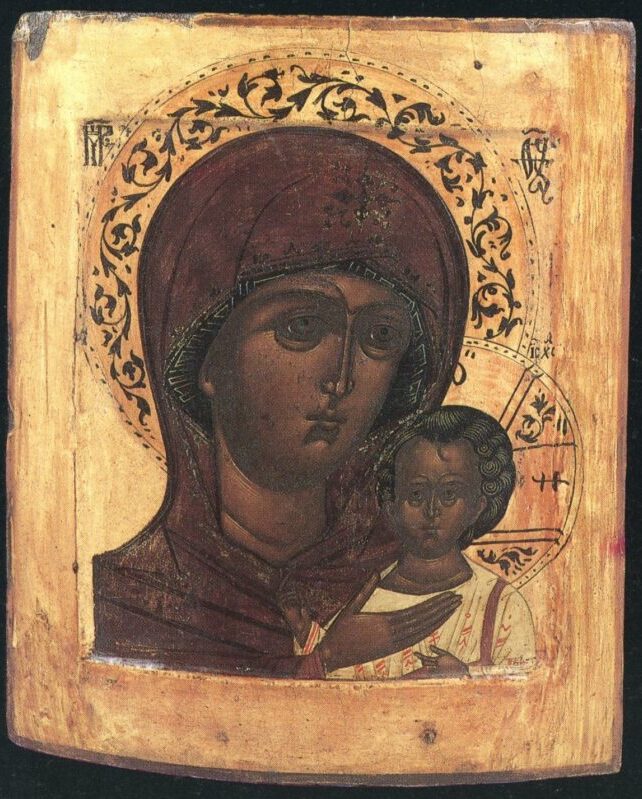
During the auctions of the larger collection, all the icons put up for sale were sold. Although the precise history of the sales has yet to be researched, it seems that one factor influencing the decision as to which icons to keep was whether Hare had discussed them in The Art and Artists of Russia. For example, the late eighteenth-century icon of Saints Florus and Laurus featured on the book’s cover image was retained, as were the three icons that are visible in a surviving photograph of Hare’s desk. This photograph shows nine icons hanging on a batik textile and another positioned across the corner of the room in the traditional Orthodox manner [fig. 3].[19] The other six works seen in this image are presumed sold or lost. Notably, many of this group have an oklad or basma(decorative and protective metal sheathing), hinting that for Hare their adornments were as valued as the icons beneath. But speculating as to Hare’s intentions is fraught with difficulty. With virtually no historical records of the purchases, assessing motives is as problematic as interpreting the works’ provenance. And there is another issue: these acquisitions happened in a limited marketplace. Many icons available in the West at the time Hare was collecting were considered then to be of low value and lacking aesthetic quality, and some of his icons fell into this bracket.

Nevertheless, the supply was there. Scholars have documented the history of the widespread removal and destruction of icons and the desecration of churches under first Bolshevik and then Soviet rule, beginning in the early 1920s and reaching a peak in the 1930s. Many looted objects ended up on the foreign marketplace. In February 1922, the Sovnarkom (Council of People’s Commissars) issued a decree, “On the confiscation of property without museum significance located in churches and monasteries,” which created a distinction between works that the Soviet authorities wished to keep and those they were willing to sell. Although rules were not strictly followed, the decree did make it far less likely that a Western collector could acquire the oldest and rarest icons.[20] (Incidentally, this largely explains why, despite the official Soviet policy of atheism, some of the major Russian museums today have such extensive holdings of icons by the likes of Andrei Rublev, Theophanes the Greek, and other revered painters, while foreign museums do not.)
Waltraud Bayer describes how the Soviet art sales to the West began. Initially, most transactions went through dealers in Germany and Austria, who enjoyed connections to the two main Soviet trading entities, Antikvariat and Gostorg. Early exports were mostly of Western European art and rarely included icons, because “the authorities feared negligible public and, consequently market interest, because such goods had no market value in the west.”[21] At this time, Hare was still at university and presumably not yet collecting. From 1928, when Antikvariat gained a monopoly on art exports, icons began to be sold in greater number. Several exhibitions were held in the West aimed at making icons more visible to potential buyers.[22] As Wendy Salmond writes, icon collecting in the West thus emerged as a direct consequence of the Soviet policy to dispose of ecclesiastical treasures to an increasingly receptive market.[23] And, she further describes how pioneering collectors, such as the Americans George Hann and Joseph E. Davies, benefited from the sale of high-quality collections specially arranged for them by Antikvariat.[24] Such arrangements were an exception to the decision to keep icons that were deemed treasured antiquities in Russia. Most often, the icons that appeared for sale in the West were newer works, frequently of lower value. But pieces with metalwork crafted by luxury makers, such as the Fabergé and Co. workshops, were available. Astute Western dealers like Armand and Victor Hammer obtained many expensive late nineteenth-century icons with imperial provenance and sold them at a profit. Another source for dealers and collectors was the sale of assets by “white Russian” émigrés who had escaped to Europe and often joined the social world of the Western elite. They included notable Byzantinists, such as Dmitry Obolensky and Nikolai Andreyev. If Gordine, herself an émigré from the Russian Empire, and Hare, a Russia specialist, mixed with this group, the evidence has yet to come to light. However, the possibility cannot be ruled out.
For the above reasons, it is hard to know precisely how Hare’s collecting fit into this broader picture.But some comparisons can be drawn between his activity and that of two twentieth-century American collectors: firstly, Davies’s divorced wife, Marjorie Merriweather Post, whose collection is now at the Hillwood Estate, Museum, and Gardens in Washington, DC, and secondly, Amy Putnam, whose collection is at the Timken Museum in San Diego.[25] Like Hare’s collection, Post’s includes a wider selection of Russian decorative art. Hillwood currently holds eighty-four icons, a comparable number to Hare’s original collection. But the Washington-based museum has many more valuable icons and Post’s earlier acquisitions were supplemented by a gift of thirty-one icons in the late 1960s.[26] By contrast, Hare’s collection was entirely his own personal selection.
Hare was more similar to Putnam, whose interest in collecting seems to have also stemmed from a broader interest in Russian literature and culture.[27] Unlike Post and her husband, whose collecting began during his assignment to Moscow, no evidence has emerged to confirm whether Hare acquired artworks while he was in Russia; however, his visit might have been a starting point for his interest.[28] It is possible that he bought from official Soviet trade organizations when he was in the USSR, from the Hammers, or from other well-known Western dealers (for example, Alexander Schaffer’s New York store, A la Vieille Russie). Some of Hare’s icons have labels for Western auction houses on the back; one has a label in Cyrillic: “Mosgostorg. Antikvarno-Khudozhestvennyi Otdel.” [29] Supply was limited in the interwar years, so it is more likely that he began collecting after the war, on the secondary market. The dating of objects in the collection—mostly nineteenth-century works—supports this theory.[30] There are no obvious links to museum collections in Russia, unlike those for some icons bought by Davies, Hann, and Post. There are no treasures from the Novgorod School (thirteenth to sixteenth centuries), nor from before the schism in the third quarter of the seventeenth century, when the Russian Orthodox Church split into two camps (namely, those who accepted the reforms spearheaded by Patriarch Nikon and those who rejected them, the so-called Old Believers).
By the mid-twentieth century, icons were available through a network of dealers and shops in the West. Oral testimony in the Dorich House Museum archives provides a few hints as to sources. A former acquaintance of theirs stated that the couple had scoured Europe, perusing fairs, flea markets, and antique shops, returning with a “car full of objects.”[31] Other purchases were made closer to home, such as the Russian art dealership The Winter Palace, set up by Nicholas Hill and located in Kensington Church Street. Margot Tracey, joint owner, recounted that she had been introduced to the Hares at a party around 1946; some objects in the collection have been linked to the shop, although to date none of the icons.[32] Tracey also recalled that the Hares bought Russian art from a Mrs. Eckstein, a dealer based in Jermyn Street in the fashionable St. James’s district of London.
Patchy Provenance: A Lost History
The dispersal at auction of most of the Hare collection heavily affected the icons. The loss was compounded by the absence of records, which likely were lost or destroyed during a period of dereliction. This creates problems with analyzing the collection today, both past and present.

The relatively small size of the original collection at less than one hundred icons is nevertheless comparable to that of other twentieth-century Western collections. The twenty icons present today represent around a quarter of the original tally of icons and other ecclesiastical objects, such as panagiaria and metal crosses [fig. 4]. They demonstrate craftsmanship in a range of methods and mediums (tempera on wood, metalwork, embroidery, and enamel) and a variety of iconographic types.[33] There are two icons of the Anastasis, one of which is of the polnitsy full-cycle) type, showing the four Evangelists and the sixteen festivals of the Church. Two other icons are portable: a Deesis triptych icon with a metal oklad and an enamel oval icon depicting Rostov miracle workers. There are two crucifix icons: a seventeenth-century wooden cross, which was one of the oldest objects in the collection, and a nineteenth-century brass crucifix set in wood (one of the very popular staurotheke icons made by Old Believers).[34]

As well as the lack of provenance, other problems arise when trying to assess the sold works. These objects were a tiny proportion of the grand total of around 2,400 art works that were listed at some fifty-four auctions, most of them open to the public and including works not limited to Gordineand Hare’s possessions.[35] However, sixty icons are listed in the catalogue of the largest exclusive sale, restricted to items from Hare’s collection, which was held at Phillips, London, in November 1994. Data from the catalogue enables the sold icons to be sorted by age, price, and type [fig. 5].[36] Most valuable by far was a sixteenth-century Russian vita icon of Saint Nicholas of Zaraisk [fig. 6], priced at £14,000–18,000. Other works of higher value than the collection average included a Petrovskaia Mother of God [fig. 7], valued at £2000–3000, and a pair of large Deesis icons that unfortunately were not photographed.[37] Some works were not Russian, including a large Cretan Entombment of Christ and a Saint George and Dragon from the Greek Islands, both dated as seventeenth century. But these were exceptions. Most icons at the auction were judged by the appraisers to be of mediocre quality and priced at a few hundred pounds or less. Some ecclesiastical crosses and pendants were listed with metalware (virtually all of which was sold). A rare sixteenth-century reliquary cross, said to still hold relics, was one of the highest valued items at £1,500–2,000.[38] The chart in figure 5 confirms that most icons dated to the nineteenth century. One such icon was Saint Antipii and Saint Michael, encased in a parcel gilt and enameled oklad. This was priced at £400–600 in 1994, which would be £750–1100 today.[39]

Hare’s decision to collect a wide array of imperial Russian art and icons was, it seems, without precedent in Britain. Indeed, the catalogue for one of the early Russian art shows in London in the Soviet period, the Exhibition of Russian Art of 1935, suggests that before World War II, British collecting of any kind of Russian art, let alone icons, was in its infancy.[40] As Anthony Cross notes, the organizers of this exhibition relied entirely on loans from private British or European collectors.[41] Many of the latter were Russian émigrés, and the catalogue reveals some key names and their collecting interests. According to the catalogue, the icons on display seem to have been primarily owned by Emlyn Reynolds.[42] Reynolds lent ten ecclesiastical art objects, including icons. Eight were listed in the “Enamels” section (two icons, a cross, two plaques, medallions of Christ and of the Virgin, and a reliquary) and two in “Jewellery” (a silver-gilt icon of Christ and an icon cover in beads and seed pearls). The fact that Reynolds’s name has vanished from the historical record suggests that this probably was the full extent of his collection.[43] Other icon exhibits came from dealers, such as Wartski and A la Vieille Russie, and émigrés, many of them Paris-based.
Another hint that Hare had no rivals is that Cyril G. E. Bunt made no mention of British collections when he published his 1946 book, Russian Art from Scyths to Soviets. For icons, Bunt illustrated works from the Hann and Lanza collections, along with a few older icons from Russian museums.[44] And in 1938, when British Byzantine-art specialist David Talbot Rice gave a public lecture on Russian icons, he relied on illustrations from Soviet publications.[45] Although such a conclusion is necessarily speculative, it seems reasonable to infer that Hare was the first British collector of significance.
Byzantine Studies in Early Twentieth-Century Britain: The 1929 Exhibition of Russian Icons in London
Although unusual, Hare’s interest in icons arguably reflects prevailing British attitudes to Russian art in the mid-twentieth century. British scholars and critics were certainly aware of Russian art, but more often this meant that of pre-Revolutionary Russia and not contemporary Soviet art, as would remain the case for much of the twentieth century. But icons were already in a somewhat different category to other kinds of Russian art due to their connection with Byzantine culture. The reception of Russian icons can thus be positioned within the broader Byzantine revival that had begun in Western Europe in the nineteenth century, which meant that some devotees of Byzantine art also extended their interests to Russian religious art.[46]
As Richard Marks observes, British views of Russian icons in the nineteenth century ranged from positive to hostile.[47] From around 1880, concomitant with new discoveries of antiquities in Central Asia and the Near East, museum communities and art writers began to take an interest in icons and ecclesiastical art.[48] A handful of Russian icons entered museum collections at this time; indeed, the British Museum and the Victoria and Albert Museum have several examples that arrived from larger private collections of Byzantine art or as single donations.[49] The first British monograph on Russian art, Russian Art and Art Objects in Russia, written by Alfred Maskell for the Victoria and Albert Museum in 1884, has two chapters on religious art that consider church architecture, metalwork, and other devotional objects including icons—the latter described by Maskell as “the chief source of the religious instruction of the Russian peasant.”[50] Subsequent British accounts were few. They include essays on icons by historian Robert Steele for two wartime publications: The Soul of Russia (1916), an interdisciplinary anthology issued to gain public support for the wartime alliance, and the catalogue for the first wide-ranging exhibition of Russian art in London, held in 1918.[51] This exhibition was notable for the inclusion of 120 icons. Echoing Maskell’s description, they were displayed in the “Peasant Art” section, thereby reflecting his perception of them as curios rather than fine art.
In the early twentieth century, interest in the art traditions of Byzantium and how these were manifested in Russian culture continued to rise.[52] A nexus with modernist circles developed as early as 1908. Two British critics, Frank Rutter and Roger Fry, presented displays of Russian art in modern art exhibitions that foregrounded ancient art and its recent revival in the avant-garde and Arts and Crafts movements. At this time, Russian painting in the academic, secular, and Westernized tradition promulgated by Empress Catherine II was largely ignored in British art circles. In autumn 1908, Rutter invited the Arts and Crafts patron Princess Maria Tenisheva to present a Russian section for his London Salon, which he had billed as showcasing the latest developments in modern art. The works selected by Tenisheva were revivalist, such as her own craft enamels modeled on Byzantine precedents [fig. 8].[53] Four years later, when Fry decided to include Russian art in his Second Post-Impressionist Exhibition of 1912, he turned to Russian émigré Boris Anrep, an artist whose retrospectively styled mosaic work again drew inspiration from Byzantium.[54] For Fry, Anrep foregrounded the Byzantine in his curatorial choices for Russian modern art. For example, for the avant-gardist Natalia Goncharova, Anrep chose her icon-inspired panels of the four Evangelists.

style, designed and made by Mariia Tenisheva, c. 1907,
dimensions unknown. Reproduced in Denis Roche, Les
émaux champlevés de la princesse Marie Ténichév (Paris,
1907). Public domain.
Such examples of neo-Byzantinism represented the Russian icon tradition at a distance once removed, for icons themselves had hardly been seen at exhibitions, even in Russia. This changed in 1913, when they were exhibited in Saint Petersburg and Moscow to celebrate the Romanov tercentenary. Many years later, Hare would acquire a copy of the catalogue for the Delovoi Dvor exhibition in Moscow, showing his knowledge of the importance of this landmark event in the acceptance of icons as art. In the ensuing decades, developments in Byzantine and Russo-Byzantine studies were reported in publications in the West, for example, in the work of the scholars Franz Bock and Louis Réau.[55] Critics like Fry took note; in the same year that he curated the Second Post-Impressionist Exhibition, Fry wrote an essay for The Burlington Magazine for Connoisseurs on John Pierpont Morgan’s acquisition of Russo-Byzantine art—examples of twelfth-century enamels from the collection of Alexander von Zwenigorodskoi [fig. 9].[56] (Morgan’s acquisition is contextualized in the essay by Mariam Charlton in the present volume.) As well as being discussed by Bock, the Zwenigorodskoi enamels had been featured in articles by Ormonde M. Dalton in recent issues, and Fry was writing in response.[57] His comments indicate the coming shift in taste: what had previously been solely of archaeological interest could now be regarded as art. Even if the attitudes of Fry and Hare differed in many ways, this was an observation that foretold the next generation’s interest in icons.

Fry distinguishes collecting for its own sake from collecting for aesthetic reasons: “The aesthete (if one may use once more a word that ought by now to have lost its unfortunate associations) looks with suspicion upon collections as such. This suspicion is natural, for the aesthete and the collector have different methods of valuation.”[58] But Fry notices how such Byzantine works as the enamels were once overlooked as “curiosities and bibelots:”
It is doubtful whether, while we were still hypnotized by the belief in the unique supremacy of Hellenistic beauty, anyone would have given prolonged attention to the Swenigorodskoi sic enamels, except as curiosities and bibelots. The first approach to such an art must have been for us through their obvious fitness for collection. They have indeed the exoticflavour, the richness and weight of material which make a strong appeal to the possessive instinct. No wonder, then, that Byzantine enamels were collected, classified, and studied by archaeologists before they were admired and understood for their intrinsic aesthetic value. Now at last our attention has been fixed on them long enough to reveal their qualities as pure works of art.[59]
For Fry, the images of saints “are fixed in lines of unrelenting certainty and by an art of drawing which the greatest of modern masters might envy.” But whereas Fry seemed to share the viewpoint of modern Russian painters, finding Byzantine art important for its formal qualities, Hare’s interest in icons seemed to tread a middle path. The range of icons in his collection suggests that he appreciated them both as “bibelot” and for their “intrinsic aesthetic value.” The difference between the approaches of Hare and Fry is further revealed by the telling fact that Hare was uninterested in collecting twentieth-century art.[60] Perhaps Hare’s interests aligned with émigré “white Russian” taste, which was, in many respects, conservative.
Fry never traveled to Russia. But another of Hare’s precursors who took an interest in Russian icons, the renowned art historian Martin Conway, visited in the early 1920s. After the formation of the Soviet Union in 1922, the British art world had maintained contact, if sporadically, and Conway visited in 1924 at the invitation of the Soviet government. On his trip, he went to Moscow, Saint Petersburg, Sergiev Posad, and a few other key sites. In Art Treasures of Soviet Russia, a book published on his return that was both travelogue and art history, Conway described the current situation regarding icons under the Bolshevik regime, hinting at the system of classification differentiating museum-quality works from those “earmarked for sale” that soon would create the new market for Western collectors like Hare. He writes:
Those icons that fell into a middle ground between . . . two extremes—of reverent care and wanton destruction – went into the Gosmuzeifond(State Museum Reserve) . . . Throughout the 1920s the depositories of the Gosmuzeifond acted as transit camps for all the major private icon collections formed before the revolution. Here they were inventoried, classified, and either redeployed to one of the new Soviet museums, earmarked for sale, or simply kept in reserve.[61]
Conway, who at the time was director of the Victoria and Albert Museum, and Fry continued to show an interest in Russian icons during the 1920s and early 1930s. Both were involved in the first project to stage a museum display of icons in London, a touring exhibition of Western capitals masterminded by the artist and Soviet arts bureaucrat Igor Grabar.[62] This major loan of icons owned by the Soviet government took place at the Victoria and Albert Museum in 1929 [fig. 10]. It was a complex Anglo-Soviet project, and in addition to Conway and Fry, the organizing committee comprised a golden cast of names from the art world, academia, and Russian émigré circles. According to Salmond, it was Fry who had suggested that the Victoria and Albert Museum host the exhibition.[63] Again testifying to their scholarship on Russian icons, both he and Conway wrote essays for the catalogue. Evidently, this was a major event in the London art world, its staging in no way hindered by difficult memories of the Russian Revolution or civil war.

Hare had moved to Paris at some point in 1929, and there is no record of whether he saw Fry and Conway’s exhibition. What he did see, though, was the associated book, Masterpieces of Russian Painting, published around the same time, as he cites it in his scholarship.[64] Leading up to the exhibition, there had been some interest in British art circles in publishing a book on Russian art. According to Galya Diment, this effort was supported by Fry, who had introduced the émigré writer Samuel Koteliansky to an editor at Chatto and Windus so that they could discuss plans for “a history of Russian art in English.”[65] The publication did not materialize, but both Fry and Conway were involved in the project by Koteliansky’s friend Mikhail Farbman to produce Masterpieces—a more narrowly scoped book. Continuing their earlier teamwork, Conway took on the role of editor.
The exhibition and Masterpieces of Russian Painting were, as Marks comments, “a seminal moment in British experience of icon-painting.”[66] They provided a foundation for later scholarship of Russian and Byzantine art and may have catalyzed Hare’s interests both as collector and writer. The post-Revolutionary years saw the appearance in the West of several books on Russian art, from Réau’s L’Art russe des origines à Pierre le grand (Russian Art from its Origins to Peter the Great, 1921) to Georgi Loukomski’s L’Art décoratif russe (Russian Decorative Arts, 1928).[67] With his multilingual skills, Hare thus had plenty of material for his own research. There was also Russian scholar Nikodim Kondakov’s foundational book, The Russian Icon, which had recently been translated into English by the historian Ellis Hovel Minns, a professor at the University of Cambridge.[68] An eminent scholar of Scythian and nomadic archaeology, Minns had also been involved in the Victoria and Albert Museum exhibition as a committee member.
“Remote Beauty” or “Historical Interest”? Icons in The Art and Artists of Russia
Around three decades after the publication of Masterpieces of Russian Painting, Hare published his own book on Russian art, including icons: The Art and Artists of Russia (1965). For reasons which are unclear, the book was first published in a German translation, with the title Tausend Jahre Russische Kunst [A Thousand Years of Russian Art] and the English version appeared the following year. Important for the present account is the fact that the book’s opening chapter is one of the earliest British scholarly accounts of the history of Russian icons. Hare’s book came out shortly before his sudden death in 1966; when he was working on it, he could hardly have expected that it would be his last word on the topic.[69] Hare stated that his motive was to fill a gap in British knowledge of Russian culture. The project also enabled him to integrate his own collection into the historiography: he used some of his own objects as illustrations and discussed them in the text. For example, his Mol’chenskaia Mother of God icon appears beside a Mother of God from A la Vieille Russie to emphasize the beauty of their oklads [fig. 11].[70] These oklads he described as representing “the majestic court art of the metropolis,” produced at the State Armory. Contrasting town and country work, Hare pictured one of his crucifixes, noting the existence of “pious and authentic but far simpler schools closer to the late Novgorod style and . . . composition [emphasis added]” (34).[71] Hare’s placing of simpler pieces alongside renowned treasures was a forward-thinking, inclusive approach to art history that was unusual for its time, and it may have developed from his training as a cultural historian as well as his experience as an art connoisseur.

Indeed, a more comprehensive understanding of Hare’s scholarship, methodologies, and approaches would require extensive biographical research that is beyond the scope of this article. For example, the bibliography in The Art and Artists includes several Russian books that may not necessarily have come from British library holdings; some of the rare books from his personal library were included in auction sales. Despite the wide-ranging sources Hare consulted for his book, he was not a specialist when it came to icons. He thanks Nikolai Andreyev for his expertise in the acknowledgments, hinting that he likely took advice from Russian scholars. Between 1938 and 1945, Andreyev was director of the Seminarium Kondakovianum in Prague, the institute founded by supporters of Kondakov in 1925, before his imprisonment by the Soviets. After escaping to Britain, Andreyev had joined the Faculty of Slavonic Studies at the University of Cambridge in 1948.[72] It is unlikely that the two men had a close connection, as Hare is not mentioned in Andreyev’s memoirs, but the Russian scholar would have been a useful local source to scholarly information on this complex topic.[73] The relationship may explain why Hare was so effusive in his praise for Kondakov in The Art and Artists of Russia, calling him “the greatest Russian art historian” (23). Although the statement seems bold, Kondakov’s work was respected among Byzantinists in the West, and the Seminarium Kondakovianum was a leading center of scholarship.
Hare’s own strong opinions abound in his chronological summary of Eastern history, even if he relied heavily on help from others. For example, he writes that the Orthodox believer eschews “the self-centered modern craving for artistic ‘originality’ and petty individual self-assertion,” (24) and he claims that figures by Dionysius, a late fifteenth-century master, are “attenuated, limp and sprawling” and display “anaemic detachment” (30). But Hare expresses approval for the seventeenth-century court painter Simon Ushakov, whom he describes as “profoundly gifted and independent-minded” (36).If it is a moot point as to why Ushakov’s independent minded approach might not have led to the despised “individual self-assertion,” Hare’s comments nevertheless reveal a dislike of experimentation. Here, the clash between Hare’s and Fry’s preferences becomes obvious. Hare was clear-sighted about the icon’s duality as both religious artifact and work of art, writing: “The icon somehow grew into the chief visible manifestation of Russian religious thought and feeling, which has survived ever since the Middle Ages. This factor alone, apart from their remote beauty, should impart to icons a unique historical interest” (25). He knew well that treating icons as art was a recent development. It had, he notes, brought a “gradual recognition of the bewildering variety, startling artistic inequality, but occasionally very high aesthetic value, of Russian religious painting” (25). The new “Russian connoisseurs” had “recognized in their subject a far-reaching and unexplored complexity” (26). Here he referenced Nikolai Likhachev and Fedor Buslaev (“Professor T. Buslaev”), probably due to his reliance on Kondakov’s text or Minns’s version of it.
Predictably, the “remote beauty” that captured Hare’s attention was the work of Andrei Rublev, which garnered his highest praise and features strikingly as the book’s frontispiece [fig. 12]. (It should be mentioned that the attribution of this particular icon to Rublev has recently been questioned.[74]) In the early fifteenth century, Hare writes, Russian religious painting “moved towards an arabesque of gentle colour harmonies, reflecting the rhythms of a mystic contemplative style, increasingly remote from hard realities and nature.”[75] Rublev, he asserts, had imbued the “Greek forms” he had inherited with “diaphanous purity and graceful inner rhythm, enhanced by an exquisite sense of colour.”[76] These poetic turns of phrase seem to reflect Hare’s knowledge of the scholarship of Pavel Muratov, another Russian scholar whose name appears in the bibliography.[77]

Hare illustrates works from the Russian Museum, the Tretyakov Gallery, the [Cathedral of the Novodevichy Convent, and Trinity-Sergius Lavra, along with icons from the former Riabushinsky, Likhachev, and Grigory and Mikhail Chirikov private collections. There are grainy images of murals, including wall paintings by Dionysius in the Ferapontov Monastery and details from the Annunciation Cathedral in the Moscow Kremlin, the Cathedral of St. Sophia in Novgorod, the Cathedral of St. Dmitry in Vladimir. An image of the well-known Stroganov icon, SaintJohn the Warrior, was probably from Hare’s copy of the abovementioned catalogue for the 1913 exhibition.[78]
There are several illustrations of works in Western collections. For example, Hare thanks “Marjorie Merriweather Post May” for photographs.[79] These included the attractive icons of the Mother of God “Pledge to Sufferers” (1795) and a seventeenth-century icon with scenes from the life of the Mother of God [fig. 13].[80] Other works from Western collections include a seventeenth-century Trinity icon from the Walters Art Gallery, shown as an example of “elaborately decorative” work of the Yaroslavl school.[81] Besides the icons in Chapter 1, other sections of the book include ecclesiastical art. For example, the chapter on silver includes discussion of a sixteenth-century Gospel cover in the Kirill-Beloozerskii monastery. Although the extent of Hare’s on-site research in Russia remains unclear, the images of works in situ suggest he had a wide knowledge of key sites and icon chronology. In sum, Hare’s skillful interweaving of sources from East and West with pieces from his own collection and his selection of illustrations to support his mainly chronological approach show a firm grounding in the topic.

Hare’s book seems to have been well received in British art circles. Highlighting the rise of interest in Russian icons, art historian Mary Chamot claimed, in 1967, that “post-war interest in the arts of Russia has been confined mainly to icon painting.”[82] Chamot remarked that the recent opening of museums dedicated to icons in Recklinghausen, Germany, and Kölliken, Switzerland, bore witness to this trend, and she emphasized a lack of literature on icons in English: “A new book, lavishly got up, is to be welcomed.”[83] She added: “Hare writes . . . with an understanding of [the icon’s] purpose ‘to represent what belonged to a separate spiritual world’ without ‘renouncing the basic physical and natural forms of life . . . The latter were deliberately stylized or adapted, to fulfil strict ecclesiastical requirements, and make the physical elements serve as a proper vehicle for conveying pure religious feelings.’” But she noticed a bias towards illustrating “later, more realistic icons.” (405). She thus recognized Hare’s approach of tackling icon history as a linear chronology that ran from Byzantium to nineteenth-century realism, a strategy that also had the benefit of positioning his own collection of mainly late icons in a positive light. Additionally, Chamot criticized Hare’s failure to mention the work of the State Restoration Workshops in Moscow or the recent exhibitions of restored icons in Russian museums: “Unfortunately some of the plates are reproduced from old photographs, before cleaning, and the present location of later paintings is not always correctly indicated.” (405).
Chamot thought that “by far the most original and useful chapters” were those on the decorative arts (406). As this praise suggests, Hare’s approach perpetuated a long-held British bias towards interpreting Russian art through the lens of the decorative arts that had begun with Maskell’s Russian Art and Art Objects. With the émigré marketplace for Russian art and antiques flourishing in the mid-twentieth century, this was another area rich for contemporary collectors. For Hare personally, Russian silver was another key area of interest. Silverware formed a large section of his collection, and he published on this topic too.[84] Thus, it was likely not mere coincidence that many of his icons bore decorative rizas and oklads (see fig. 3).
Unlike Chamot, Hare was not a trained art historian, but he had researched both Western and Russian sources. Few were Soviet: most of the scholars Hare cites are Russian and from pre-Revolutionary and émigré circles; they include Aleksandr Anisimov, Nikodim Kondakov, Nikolai Likhachev, Pavel Muratov, Aleksandr I. Uspensky, Vladimir Lossky, and Leonid Uspensky. He names several scholars based in Germany too: Konrad Onasch, Vladimir [“W.”] Weidle [a Russian émigré], and Oskar Wulff. As to Western sources, Hare references British art historian David Talbot Rice’s short, forty-page primer, Russian Icons [fig. 14], published by Penguin in 1947. But he omits the more comprehensive text by Tamara Talbot Rice, Russian Icons, as well as her A Concise History of Russian Art and Russian Art, all of which came out in 1963, two years before his book.[85] Perhaps he viewed them as competition or perhaps his research was executed piecemeal. Other important works of twentieth-century Western scholarship are missing too, such as Fannina Halle’s Altrussische Kunst (Old Russian Art, 1920) and Réau’s L’art russe (Russian Art, 1921).[86]

Icons (King Penguin series) (London:
Penguin, 1947), designed by Enid Marx.
Photograph © 2025 Louise Hardiman.
Hare’s Connections with Other Western Collectors and Scholars
Records of Hare’s contacts and travels are practically nonexistent, and the suggestions that follow are speculative. For instance, might he have traveled to Prague to visit the Seminarium Kondakovianum?[87] It is possible, but Hare probably met Andreyev in Cambridge, since the exiled scholar was already there by 1948. Did Hare know Minns, also at Cambridge? While a Prague connection is impossible to confirm, it seems almost certain that Hare knew collectors in Germany, Switzerland, and the United States, either personally or indirectly. His articles on icons for The Connoisseur indicate his knowledge of the collections of Siegfried Amberg-Herzog (1924–2002) at Kölliken and Martin Winkler (1893–1982) and Heinrich Wendt (1901–56) at Recklinghausen.[88] Hare’s research and contacts show gaps, however. Some important mid-twentieth-century collections that he does not mention are: the Olof Aschberg collection of 245 icons, which the National Museum of Sweden in Stockholm purchased in 1933; the much smaller Allen collection at the National Gallery of Ireland, Dublin, which was purchased in 1968 but assembled earlier; and the collection of the Kunsthistorisches Museum, Vienna.[89] Such projects bear comparison with Hare’s own, so the omissions are surprising and especially so in the case of Allen, given Hare’s personal connections to Ireland.
Perhaps the most interesting link with other collectors is the fact that the German version of Hare’s book was published by the Aurel Bongers Press in Recklinghausen. Apart from slight alterations to design, this publication was no different from the English version, and it is unclear why it came out a year earlier.[90] What is intriguing is that the press had a strong relationship with the Recklinghausen Museum of Icons. When the latter was founded in 1956, its home was the building used by the publisher, which began to produce art books on icons in collaboration with the museum.[91] Hare evidently knew people there, and perhaps his book was linked to a museum exhibition, or he had heard of the new collaboration when looking for a publisher. The museum was founded by the director of the Kunsthalle Recklinghausen, the painter Thomas Grochowiak (1914–2012), after a successful exhibition of icons at the Kunsthalle.[92] It assembled for permanent display seventy-three icons from the collections of Winkler and Wendt, who were the most significant collectors of icons in Germany at the time.[93]
Hare’s collection was comparable in size to the founding collection at Recklinghausen, and although he may not have known the donors themselves, he likely did know the museum’s director, Heinz Skrobucha. In the 1964 issue of The Connoisseur, Hare reviewed Skrobucha’s Meisterwerke der Ikonenmalerei (Masterpieces of Icon Painting), also published by Aurel Bongers, praising this “much-needed short survey of the complicated history of icon painting.”[94] He noted that Skrobucha had reproduced, for the first time, icons from the collections of Amberg, George Hann, and “Professor Martin Winkler in Munich.” The comment reveals Hare’s awareness of some key players in the icon community. There was, it seems, an international group of connoisseurs who wished to raise the status of icon scholarship and collecting. Also in 1964, Hare reviewed Konrad Onasch’s Ikonen (1963), enthusing about this “most welcome addition to the very scanty literature in English devoted to the study of Russian icons.”[95] He congratulated the author for including several illustrations of work by Ushakov, whom “purists could never forgive for his departure from the old theological canons,” as well as some later eighteenth-century icons.[96] But he criticized Onasch’s separation of the text from the illustrations, the lack of captions, and the failure to tackle key issues, such as the retouching of original icons during restoration.
Hare’s status as one of the very few British writers on Russian art during Soviet times must surely also have led to contact with Byzantine art specialists and enthusiasts within the scholarly and museum communities. It is helpful to compare his writing to that of two scholars whose work in promoting the cause of Russian art in twentieth-century Britain remains under-researched: the Byzantine art specialists David Talbot Rice (1903–1972) and his wife, Tamara Talbot Rice (née Elena Abelson, 1904–1993).[97]
Born in Gloucestershire in 1903, David Talbot Rice, like Hare, had a conventional upper-class education, in this case at Eton College followed by Oxford University. He had a somewhat similar role to Hare during the Second World War, working with the Intelligence Directorate of the War Office, ultimately becoming head of its Near East section. Talbot Rice then became a renowned specialist on Byzantium and wrote many works on Byzantine and Islamic art.[98] This interest was fostered by extensive travel in the Near East, and in 1932, Talbot Rice was appointed lecturer in Byzantine and Near Eastern Art at the recently founded Courtauld Institute of Art in London. After two years, he gained a professorship at Edinburgh University, which he held for most of his career.
Besides his book Russian Icons, published in 1947 for the King Penguin series, Talbot Rice’s publications on Byzantine art occasionally featured Russian work.[99] Although there is no discussion of icons made in Russia, Art of the Byzantine Era mentions Byzantine art objects and icons located at the Pushkin Museum, the State Hermitage Museum, and the State Tretyakov Gallery. Clearly, Talbot Rice was well versed with the contents of Soviet museums.[100] Churches and frescos in Georgia and Armenia are also discussed. Additionally, Talbot Rice had been involved in Russian icon projects in Britain: he was a member of the Executive Committee for the Russian Art Exhibition of 1935, and, within this, was part of a more narrowly constituted selection committee. Around the time of the exhibition, he wrote an essay for The Burlington Magazine in which he questioned Anisimov’s view on the origins of Russian icon painting; he wished to stress that there were ongoing relations between Constantinople and Kyiv.[101] Also, in autumn 1937, Talbot Rice gave an invited lecture on the beginnings of Russian icon painting as part of the prestigious series of Ilchester lectures on Polish and Slavonic history and culture at Oxford University’s Taylor Institution.[102]
Another interesting commonality was that both Hare and Talbot Rice married women who were émigrés from the Russian Empire. It is possible that their wives might have nudged their interests in the direction of Russian cultural history; both their respective spouses may have assisted in their research, too, despite having careers of their own. Talbot Rice married Tamara Abelson in 1927 after meeting her at university. But unlike the artist and sculptor Gordine, Abelson pursued a career as an academic and author. Although she had trained as a Byzantine specialist, she leaned toward writing works for the general reader and published a long list of books under her married name, many of them on Russian history. Her Russian Icons, first published in 1957, was so successful that it went to several reprints.[103] And her interests in Russia ranged more widely than those of her husband, including the Scythians, Empress Elizabeth, and the events of the twentieth century.[104] Tamara Talbot Rice’s A Concise History of Russian Art remains a rare introduction to the subject that, although its approaches would be questioned by contemporary scholars, has not been superseded by later publications.[105] The Talbot Rices also collaborated on many projects, including the 1935 Russian Art Exhibition, an exhibition and catalogue of the Allen collection, and a book on icon dating.[106]
By comparison with the Talbot Rices, then, whose scholarship on the Russian icon was informed by a far broader engagement with Byzantine art, Hare’s publications seem almost to be the result of a connoisseurly enthusiasm that had developed into an academic sideline. And in terms of Russian art historiography, his modest output hardly bears comparison with the long list of publications by Tamara Talbot Rice. But, whatever differences one might draw between them in terms of their contributions to scholarship, this trio of writers created a body of new British art writing on Russian icons, and Russian art more generally, which greatly influenced the next generation of historians. In the work of all three, it is possible to trace a line back to the interests and scholarship of Maskell, Fry, Conway, and others.
Circles of Influence: Looking beyond Hare
The purpose of this essay has been not only to assess Hare’s own collecting activity as it concerned Russian icons but also to position his interest within a broader context of British interest in Russian art in the twentieth century—a topic that is ripe for further scholarly investigation. Although, as noted, much of the primary evidence of Hare’s work is lost, I have argued that Hare’s engagement with Russian icons should be seen as consistent with the rise of interest in Byzantine art in the West during the late nineteenth and twentieth centuries. A growing British awareness of Russian art more broadly was linked with these developments, as revealed by a brief comparison with the work of the Talbot Rices. The publications of the Talbot Rices and Hare can be credited with making Russian art more widely known in Britain. For Hare specifically, writing a survey text on this topic was also entirely consistent with his wish that his and Gordine’s own collection would become the starting point for a Russian art museum in Britain. Hare can be seen as a pioneer who broke out on his own with assembling his collection, since his decision to acquire later icons went against the main voices of the twentieth-century art world, including critics like Fry and historians like the Talbot Rices. With his combined collecting and writing, notably transcending the academic setting, Hare was able to support emerging Western connoisseurship as well as wider public interest in Russian artistic culture. As a mediator, then, he can also be compared with the English musicologist Rosa Newmarch, whose books The Russian Opera (1914) and The Russian Arts (1916) were early examples of introductory primers on Russia for British readers.[107] Like Newmarch, Hare fits best in the role of cultural educator. To conclude, regardless of the quality of his own icon collection or his scholarship, Hare’s pioneering work bears witness to a new Western perception of icons as art during the Soviet period. Accordingly, while the remaining collection in the Dorich House Museum is small, bound with its history lies a larger untold story of Anglo-Soviet cultural relations that brings fresh insights into the long history of British-Russian artistic exchange.
[1] This
article is an extended version of a paper presented at the 2021 Virtual
Conference of the Museum of Russian Icons, “Collecting Orthodox Art in the
West: A History and Look Towards the Future.” I thank the attendees for their
helpful observations, and the journal editors and Brenda Martin, Fran Lloyd,
and Dorich House Museum curator Fiona Fisher for their comments on earlier
drafts of this article.
For a catalogue of icons held by the British
Museum, of which the Russian works are a subcategory, see note 53 below. No
similarly comprehensive catalogue exists for icons in the Victoria and Albert
Museum collection, but a non-comprehensive list of works held can be viewed by
entering the keyword “Russian” and selecting the object type “icon” at https://collections.vam.ac.uk/search/.
Likewise, icons at Dorich House Museum are not fully catalogued, but
photographs can be viewed at https://www.dorichhousemuseum.org.uk/collections/russian-collections/.
[2] There is scant literature on Anglo-Soviet artistic relations.
Exceptions include Anthony Cross, “Two Exhibitions: Exhibiting Russia: The Two
London Russian Exhibitions of 1917 and 1935,” Slavonica 16, no. 1 (2010): 29–39;Verity
Clarkson, “‘Sputniks and Sideboards’: Exhibiting the Soviet ‘Way of Life’ in
Cold War Britain,” in A People Passing
Rude: British Responses to Russian Culture, ed. Anthony Cross (Cambridge:
Open Book Publishers, 2012), 285–300, https://doi.org/10.11647/OBP.0022; and Galina Mardilovich, “An Unusual Gift of Russian Prints to
the British Museum in 1926,” The Burlington
Magazine 159, no. 1371 (June 2017): 453–59.
[3] Dorich House was in poor repair at the time of Gordine’s death in 1991. Squatters briefly occupied the
house, and it was subsequently used as a film set by the BBC. In 1994, Dorich
House was acquired by Kingston University. A decision was made to reduce the
art collection to support a full historic renovation of the building. This
disruptive phase immediately after Gordine’s death
had another major consequence—few of Hare’s papers have survived. Hare’s life
has yet to be researched fully, and there has been little detailed research on
the icon collection, so dates from museum records quoted here may be
unreliable.
[4] Richard Hare, The Art and
Artists of Russia (London: Methuen, 1965).
[5] On British responses to Byzantium, see: Robin Cormack and Elizabeth
Jeffreys, eds., Through the looking glass: Byzantium through British eyes. Papers from the Twenty-Ninth Spring Symposium of
Byzantine Studies, King’s College, London, March 1995 (Aldershot: Ashgate/Variorum,
2000).
[6] The Earls of Listowel also held the
title Viscount (or Lord) Ennismore; many served as members of Parliament and later
as Whigs (the Liberal Party). Among them was Hare’s great-grandfather, William
Hare, Third Earl of Listowel (1833–1924), who fought
in the Crimean War. The family properties in Ireland, Listowel
Castle and Convamore Castle, both fell into ruin, the
latter destroyed by the Irish Republican Army in the Irish War of Independence.
Richard Hare’s older brother, William Francis Hare (1906–97), Fifth Earl of Listowel, turned to Labour
politics and dropped his title, becoming known as “Billy Listowel.”
[7] The family earldom was named for Listowel, a town in County
Kerry, Ireland.
[8] Gordine was Jewish and born in Latvia.
She lived in Estonia as a young woman and became an Estonian citizen after the
country’s declaration of independence in 1918. (Estonia was part of the Russian
Empire between 1710 and 1917.) On Gordine, see
Jonathan Black and Brenda Martin, Dora
Gordine: Sculptor, Artist, Designer (London: Philip Wilson, 2007); and
Jonathan Black, “Collecting Connoisseurs and Building to House a Collection:
The Intriguing Case of Dora Gordine (1895–1991),” Journal of the History of Collections
21, no. 2 (October 2009): 253–61.
[9] Black and Martin, Dora
Gordine, 56–57.
[10] Black and Martin, Dora Gordine, 56–57. See also Bertha Malnick, “Richard Gilbert Hare,
1907–1966,” Slavonic and East European
Review 45, no. 105 (July 1967): 271–72..
[11] Jonathan Black and Fran Lloyd, Subtlety and Strength: The Drawings of Dora Gordine
(London: Philip Wilson, 2009), 34.
[12] Black and Lloyd, Subtlety
and Strength, 62–63.
[13] Originally part of Kings College London, the institution is now
part of University College London (UCL).
[14] Richard Hare, Maxim Gorky:
Romantic Realist and Conservative Revolutionary (London: Oxford University
Press, 1962); and Richard Hare, Russian
Literature from Pushkin to the Present Day: Portraits of Russian Personalities between Reform and Revolution (London:
Oxford University Press, 1962).
[15] See, for example, Ivan Turgenev, Fathers and Children, and Rudin, translated by Richard Hare
(London: Hutchinson International Authors, 1947); and Ivan Bunin, Dark Avenues, and Other Stories,
translated by Richard Hare (London: John Lehman, 1949). A complete bibliography
would be too long to include here.
[16] “Russian” may still include some objects whose origin should
correctly be attributed to colonized and occupied lands that were formerly
within the Russian Empire or under its control (for example, Ukraine, Poland,
and the Baltic States); the museum’s efforts to research and catalogue the
collection are ongoing.
[17] Stolitsa i usad’ba: Zhurnal “Krasivoi zhizni” (Petrograd:
1913–17); Khudozhestvenn
[18] The other notable private collections of Imperial Russian and
Soviet art in Britain at the time were those of émigrés: that of Ukrainian
diplomat Mikhail Braikevitch was bequeathed to the
Ashmolean Museum, Oxford, in 1940, and that of Zia Wernher, would eventually
reside in Ranger’s House (now owned by English Heritage).
[19] Maren Friedman to Brenda Martin, February 5, 1995. Dorich
House Museum Archive. In the Russian tradition, icons
are traditionally displayed hung across the corner of a room, whether in a
peasant hut or a tsar’s bedchamber; this corner is known as the krasnyi ugol (red or
beautiful corner).
[20] See Anne Odom and Wendy R. Salmond, “Introduction: From
Preservation to the Export of Russia’s Cultural Patrimony,” in Treasures into Tractors: The Selling of
Russia’s Cultural Heritage, 1918–1938, ed. Anne Odom and Wendy R. Salmond
(Seattle: University of Washington Press, 2009), 11–12.
[21] Waltraud Bayer, “Soviet Art Sales to Europe, 1919–1936,” in Odom
and Salmond, Treasures into Tractors,
185–213, at 197.
[22] Wendy Salmond, “Russian Icons and American Money, 1928–1938,” Canadian–American Slavic Studies, 43, nos. 1–4 (2009):
273–304, reprinted in Odom and Salmond, Treasure
into Tractors, 237–63, at 242–43. See also E. A. Osokina,
Nebesnaia golubizna angel’skikh odezhd: Sud’ba proizvedenii drevnerusskoi zhivopisi, 1920–1930-e
gody (Moscow: O.O.O. “Novoe
literaturnoe obozrenie,”
2018).
[23] Salmond, “Russian Icons and American Money.”
[24] Salmond, “Russian Icons and American Money,” 251–57. On the Hann
collection, see also George R. Hann and Andrey Avinoff, Russian Icons and Objects of Ecclesiastical and Decorative Arts from
the Collection of George R. Hann, exh. cat. (Pittsburgh:
Carnegie Institute Press, 1944).
[25] Post’s collection included not only Davies’s icons but her own
later acquisitions of Russian art and icons. See Wendy Salmond, Russian Icons at Hillwood (Washington,
DC: Hillwood Museum and Gardens, 1998). On Putnam, see https://www.timkenmuseum.org, accessed August 16, 2022. The Hillwood Museum was established
after Post’s death, supported for posterity by the family trust.
[26] Salmond, Russian Icons at
Hillwood, 16.
[27] See Derrick Cartwright’s article “From Forges to Fiery Furnaces:
Amy Putnam and the Timken Museum’s
Russian Icon Collection” in this issue.
[28] Salmond, Russian Icons at
Hillwood, 12.
[29] This label indicates that the icon was originally sold through
one of the Soviet retail outlets in the 1930s, but that it could have reached
the Western market through a variety of avenues (thus, Hare may have purchased
it in the USSR or in the West). The author is grateful to Wendy Salmond for
this information.
[30] Wendy Salmond, “How America Discovered Russian Icons: The Soviet
Loan Exhibition of 1930–32,” in Alter
Icons: The Russian Icon and Modernity, edited by Douglas Greenfield and
Jefferson Gatrall (University Park: Pennsylvania State
University Press, 2010), 128–43.
[31] Interviews file, DGH/9/1, Dorich House Museum Archive.
[32]
Interviews file, DGH/9/1, Dorich House Museum Archive.
[33] They comprise: three icons of Christ with the Mother of God, some
with accompanying figures; two icons of the Mother of God (“Molchensky,”
“Kazan,” and “Virgin of the Sign” types); two of angels (Archangel Gabriel and
an Old Testament Trinity); and five of saints (John the Baptist, two of Nicholas
[one in very poor condition], Florus and Lavrus, and Dymytrii Tuptalo [Dimitry of
Rostov]).
[34] In addition, there is one Greek icon in the collection, a
seventeenth-century Presentation of the
Virgin.
[35] See Alison McGregor, “Stars at Auction: Exploring the Sales
of Dora Gordine and Richard Hare’s Private Art
Collection,” in The Squatter Years: Recovering Dorich House Museum’s
Recent Past (London: Dorich House Museum, 2021). https:
//dorichhousemuseum.org.uk/2021/01/21/stars-at-auction-exploring-the-sales-of-dora-gordine-and-richard-hares-private-art-collection/.
McGregor’s research concluded that the first auction took place on August 15, 1994 and the final ones were held on May 8 and 9, 1997.
[36] The definitions of type are less exact, as many of the auction
catalogue entries were vague. Around half of the offered lots were illustrated
in black and white, and there were a few further images on the front and back
cover.
[37] A Collection of Russian Works of Art.
Tuesday 15 November 1994 at 11 am (London: Phillips,
1994), no. 330, sale cat., November 15, 1994.
[38] The inscription describing the relics is unfortunately not
recorded in the catalogue, which contains a photograph of the front of the
cross but not the reverse.
[39] Calculated according to prevailing exchange rates on September
16, 2022.
[40] Catalogue of the Exhibition
of Russian Art: 1 Belgrave Square, London S.W. 1, 4th June to 13th July, 1935, exh. cat. (London:
Oliver Burridge, 1935), https://archive.org/details/RussianArt/mode/2up.
[41] Cross, “Two Exhibitions.” 36
[42] Icons had a separate section in the exhibition, but some icons
with features that overlapped with another section, such as jewelry, were
placed elsewhere.
[43] My brief research has yielded no information about Reynolds, but
historical auction house records might prove fruitful.
[44] Cyril G. E. Bunt, Russian
Art from Scyths to Soviets (London: The Studio,
1946), 81–122, esp. 87–89, 115–21, for illustrated works from private
collections. I have not been able to identify the “Lanza” collection.
[45] David Talbot Rice, The Beginnings
of Russian Icon Painting: Being the Ilchester Lecture Delivered in the Taylor
Institution, Oxford, on 19 November 1937 (Oxford: Oxford University Press,
1938).
[46] On the revival, see Richard Bullen, Byzantium Rediscovered: The Byzantine Revival in Europe and America
(London: Phaidon, 2006).
[47] Richard Marks, “Russian Icons through British Eyes, 1830–1930,”
in Cross, A People Passing Rude, 69–68, https://books.openbookpublishers.com/10.11647/obp.0022/chap04.html.
[48] On the rise of interest in Russian art at the South Kensington
Museum (now the Victoria and Albert Museum), see Louise Hardiman, “The ‘Martinoff Drawings’: A Quest for Russian Art at the South
Kensington Museum,” The Burlington
Magazine 160, no. 1389 (2018): 1006–15.
[49] Robin Cormack, Maria Vassilaki and Eleni Dimitriadou, eds., “A
Catalogue of the Byzantine and Greek Icons in the British Museum,” The Icon
Museum and Study Center, https://www.iconmuseum.org/british-museum-catalogue/
accessed March 27, 2025.
[50] Alfred Maskell, Russian Art
and Art Objects in Russia: A Handbook to the Reproductions of Goldsmiths’ Work
and other Art Treasures from That Country in the South Kensington Museum, 2
vols. (London: Chapman & Hall, 1884), 2:149–183, 184–207, at 165.
[51] The Triple Entente in opposition
to Germany and its alliance comprised France, Britain, and Russia, with other
countries joining later. Cross, “Two Exhibitions,” 29–39.
[52] A key British publication of the period was Ormonde M. Dalton, Byzantine Art and Archaeology (Oxford:
Clarendon, 1911).
[53] On the Russian art displayed at the 1908 exhibition, see Louise
Hardiman, “‘Infantine Smudges of Paint . . . Infantine Rudeness of Soul’:
British Reception of Russian Art at the Exhibitions of the Allied Artists’
Association, 1908–1911,” in Cross, A
People Passing Rude, 133–47, https://doi.org/10.11647/OBP.0022. On Fry’s exhibition, see Caroline MacLean, The Vogue for Russia: Modernism and the Unseen in Britain, 1900–1930 (Edinburgh:
Edinburgh University Press, 2015), 34–45.
[54] Roger Fry, ed. Grafton Galleries. Second
Post-Impressionist Exhibition. British, French and Russian Artists. Oct 5 – Dec
31 1912, exh. cat. (London: Grafton
Galleries, 1912).
[55] Franz Bock, Die byzantinischen Zellenschmelze der
Sammlung Dr. Alex. von Swenigorodskoï und das darüber veröffentlichte
Prachtwerk (Aachen, Germany: La Ruelle’sche Accidenzdruckerei,
1896); and Louis Réau, L’art russe des origines
à Pierre le Grand (Paris: H. Laurens, 1921).
[56] Roger Fry, “An Appreciation of the
[57] Bock, Byzantinischen Zellenschmelze;
and Ormande M. Dalton, “Byzantine Enamels in Mr.
Pierpont Morgan’s Collection,” The Burlington
Magazine for Connoisseurs 21, no. 109 (1912): 2–5, 8–10.
[58] Fry, “Appreciation of the
[59] Fry, “Appreciation of the
[60] Notably, though, Hare had provided the financial support for the
building of Dorich House with designs by Gordine, which were distinctively
modernist. Her approach as a sculptor was more figurative than abstract
tradition, in this sense, the couple may have shared a taste for the less
radical. There is, however, some evidence that they had links to British
modernist circles, as Gordine knew some members of
the Bloomsbury Group.
[61] Sir Martin Conway, Art
Treasures in Soviet Russia (London: Edward Arnold, 1925), 32.
[62] Ellis H. Minns, ed., Ancient
Russian Icons from the XIIth to the XIXth centuries, Lent by the Government of the U.S.S.R. to
a British Committee and Exhibited by Permission at the Victoria and Albert
Museum, London (18 November–14
December 1929), exh. cat. (London: Victoria and
Albert Museum, 1929). The exhibition also toured Berlin, Frankfurt, Paris,
Vienna, New York, and other cities. See, for example, Denkmäler
altrussischer Malerei: Russische Ikonen vom 12.–18. Jahrhundert: Austellung des
Volksbildungskommissariats der RSFSR und der Deutschen Gesellschaft zum Studium
Osteuropas in Berlin, Köln, Hamburg, Frankfurt a. M., München, Februar/Mai 1929,
exh. cat. (Berlin: Ost-Europa, 1929); Aleksandr Anisimov, Erforschung der Ikonenmalerei: Begleittext zur Ausstellung “Denkmäler
altrussischer Malerei” in Deutschland 1929, ed. Erika Voigt (Frankfurt am Main: Peter Lang, 2011); Anastasia Lishnevskaya, “Russian Icons in Germany: The Exhibitions of
1929,” in “Germany—Russia: On the Crossroads of Cultures,” special issue, Tretyakov Gallery Magazine 70, no. 1
(2021), https://www.tretyakovgallerymagazine.com/articles/1-2021-70/russian-icons-germany-exhibition.
[63] Roger Fry to E. R. D. MacLaghlan, May
21, 1929, Victoria and Albert Museum archives, VX.1929–006, cited in Salmond,
“Russian Icons and American Money,” 141n18. On the London exhibition, see also
Marks, “Russian Icons”; and V. Veidle [Wladimir
Weidlé], “Russkie ikony v Londone,” Vozrozhdenie, December 14, 1929, cited in Salmond, “Russian
Icons and American Money,” 141n16.
[64] Michael Farbman, ed., Masterpieces
of Russian Painting (London: Europa, 1930).
[65] Galya Diment, A Russian Jew
of Bloomsbury: The Life and Times of Samuel Koteliansky (Montreal: McGill
Queens University Press, 2011), 122n2.
[66] Marks, “Russian Icons through British Eyes.”
[67] Réau, Art russe; Georgi Loukomski [Georgii
Lukomskii], L’art
décoratif russe (Paris: Vincent, Fréal
& cie, 1928).
[68] The story of Minns’s painstaking efforts
to adapt Kondakov’s book for a Western audience,
taking account of the most recent developments in cleaning, restoration, and
interpretation of icons in Russia, is recounted in Wendy Salmond, “Ellis H.
Minns and Nikodim Kondakov’s The Russian
Icon (1927),” in Modernism and the
Spiritual in Russian Art: New Perspectives, ed. Louise Hardiman and Nicola Kozicharow (Cambridge: Open Book Publishers, 2017), 165–94,
https://doi.org/10.11647/OBP.0115.08.
[70] This mention may also provide a clue as to one of Hare’s contacts
in the Western marketplace for icons.
[71] Parenthetical citations are to Hare, Art and Artists of Russia.
[72] See Francesco Lovino, “Communism versus Seminarium Kondakovianum,” Convivium: Exchanges and Interactions in the Arts of Medieval Europe,
Byzantium, and the Mediterreanean 4, no. 1 (2017):
142–57, at 153; Laurens Hamilton Rhinelander, “Exiled Russian Scholars in
Prague: The Kondakov Seminar and Institute,” Canadian Slavonic Papers / Revue Canadienne
des Slavistes 16, no. 3 (1974), 331–52.
Rhinelander describes Andreyev as an “acting” director (340).
[73] Nikolai Andreyev, A Moth on
the Fence: Memoirs of Russia, Estonia, Czechoslovakia, and Western Europe,
trans. Patrick Miles (London: Hodgson, 2009).
[74] Robin Milner-Gulland, Andrei
Rublev: The Artist and His World (London: Reaktion
Books, 2023).
[75]
Hare, Art and Artists of Russia, 29.
[76] Hare, Art and Artists of Russia, 30.
[77] I thank Wendy Salmond for this observation.
[78] Dorich House Museum Archives.
[79] Merriweather Post took the surname of her fourth husband, Herbert
A. May, until their divorce in 1964.
[80] For a color image, see Salmond, Russian Icons at Hillwood, 51.
[81] Hare, Art and Artists of
Russia, 31, 51, pl. 11. Now named the Walters Art Museum, the gallery was
founded with a bequest in 1931 by Henry Walters of his, and his father
William’s, broad-ranging art collection, with notable holdings in Byzantine and
Russo-Byzantine art. The Walters’ icons thus were acquired well before those of
Hare.
[82] Mary Chamot, review of The
Art and Artists of Russia, by Richard Hare, Journal of the Royal Society of Arts 115, no. 5129 (1967): 405–6.
Parenthetical citations below are to this article.
[83] Chamot, review of The Art and
Artists of Russia, 405.
[84] “Russian Silver by R. G. Hare,” in The Connoisseur Complete Encyclopedia of Antiques, ed. Leonard G.
G. Ramsay (New York: Hawthorne, 1962), 60–65.
[85] Tamara Talbot Rice, A
Concise History of Russian Art (New York: Frederick A Praeger, 1963);
Tamara Talbot Rice, Russian Art
(London: Pelican, 1963); and Tamara Talbot Rice, Russian Icons (London: Spring Books, 1963).
[86] Fannina Halle, Altrussische Kunst (Berlin: Ernst Wasmuth, 1920); Louis Réau, Art russe.
[87] Hamilton Rhinelander, “Exiled Russian Scholars,” 331.
[88] Richard Hare, “The Icon Museum at Recklinghausen,” The Connoisseur (October 1963): 104–8; and
Richard Hare, “Dr Siegfried Amberg’s Collection of Icons,” The Connoisseur (January 1966): 7–11. Amberg
(1885–1959) was based in Kölliken, Switzerland, and
it is thought that the collection remains in private hands. Amberg’s collection
was exhibited at the Recklinghausen Museum in 1963. See Ikonen: Sammlung Amberg, exh. cat. (Recklinghausen, Germany: Städtische
Kunsthalle, 1963).
[89] Robin Cormack, “The Icon: Past, Present, and Future,” in Gates of Mystery: The Art of Holy Russia, ed. Roderick Grierson, exh. cat. (Cambridge: Lutterworth,
1994), 324. The Allen collection comprised twenty-four icons purchased by W. E.
D. Allen and donated to the gallery in the name of his wife, Natasha Allen. It
was catalogued by David and Tamara Talbot Rice, who published their findings as
Icons: The National Gallery of Ireland (The Natasha Allen Collection) (Dublin:
National Gallery of Ireland, 1968). A cursory examination of the gallery’s
online catalogue indicates that ten of these were Russian. See https://www.nationalgallery.ie, accessed October 24, 2021. On the Aschberg
collection, see Olof Aschberg and Helge Kjellin, Icones Russes: Collection Olof Aschberg; Donation faite
au Musée Nationale, Catalogues d’expositions du Museé National
45 (Stockholm: Nationalmuseum, 1933). On Vienna, see Karoline Kreidl-Papadopoulos,
“Die Ikonen im Kunsthistorischen Museum in Wien,” Jahrbuch der Kunsthistorischen Sammlungen in Wien 66, n.s., 30
(1970): 49–134.
[90] Full-page illustrations are more plentiful in the German edition,
and Hare credits the publisher for the preparation and printing of the colorplates used in the British edition.
[91] E. Henze, “Bongers, Aurel,” in Lexikon des gesamten Buchwesens Online
(Leiden: Brill, 2014; first published online 2017). After its books on icons, the press turned to new topics, such as
art and history of Southeastern Europe, French illuminated manuscripts, and
twentieth-century painting.
[92] See “Gründung,” Ikonen-Museum
Recklinghausen, https://ikonen-museum.com/ikonen-museum/gruendung, accessed September 22, 2021.
[93] “Gründung,” Ikonen-Museum
Recklinghausen. My inquiry in 2021 to the Recklinghausen Museum, which still
exists, did not elicit any evidence about past relationships with Hare.
[94] Richard Hare, review of Meisterwerke der Ikonenmalerei, by Heinz Skrobucha, The Connoisseur 154 (April 1963): 125.
[95] Richard Hare, review of Icons,
by Konrad Onasch, The Connoisseur 154
(1963): 190–92.
[96] Hare, review of Icons.
[97] On David Talbot Rice, see “Talbot-Rice, David,” in Who’s Who, 1968–1969: An Annual Biographical Dictionary (New
York: St. Martin’s Press, 1968), 2567, https://archive.org/details/whoswho19681969a00newy. On Tamara Talbot Rice, see Dictionary of Art Historians, Duke
University, https://arthistorians.info/ricet, accessed November 30, 2021; Olga Morgunova Petrunko, “Mezhdu trekh imperii:
Tamara Tolbot-Rais. Zhizn’ i rabota,” https://www.scotland-russia.llc.ed.ac.uk/wp-content/uploads/2019/02/Tamara-Talbot-Rice-in-Russian-Language-Abroad.pdf, accessed September 13, 2022; and Tamara Talbot Rice, Tamara: Memoirs of St Petersburg, Oxford,
and Byzantium, ed. Elizabeth Talbot Rice (London: John Murray, 1996).
[98] Rice also organized several important exhibitions of Byzantine
art, including a major display in 1958 for the Edinburgh International Festival
(later transferred to London).
[99] For example, Byzantine Art
(1935), Byzantine Painting and
Developments in the West before A.D. 1200 (1948), Art of the Byzantine Era (1963), and Byzantine Art, the Last Phase (1968).
[100] David Talbot Rice, The Art
of the Byzantine Era (Oxford: Thames and Hudson, 1963), 41, 64, 126–27,
238–45.
[101] David Talbot Rice, “The Origins of Russian Icon Painting,” The
Burlington Magazine for Connoisseurs
67, no. 388 (July 1935): 36–37, 41, at 36. The Anisimov source was the
historian’s essay for Masterpieces of
Russian Painting.
[102] David Talbot Rice, The
Beginnings of Russian Icon Painting: Being the Ilchester Lecture Delivered in
the Taylor Institution, Oxford, on 19 November 1937 (Oxford: Oxford
University Press, 1938).
[103] Tamara Talbot Rice, Russian
Icons; Tamara Talbot Rice, Icons
(London: Batchworth, 1959, 1960, 1962).
[104] Along with A Concise
History of Russian Art, a brief bibliography of works by Tamara Talbot Rice
includes The Scythians (London:
Thames and Hudson, 1957); Russian Icons;
Tamara Talbot Rice, The Seljuks in Asia
Minor, Ancient Peoples and Places
20 (London: Thames and Hudson, 1961);
Ancient Arts of Central Asia (New York: Praeger, 1965); Everyday Life in Byzantium (New York:
Barnes & Noble, 1994, 1967); and Elizabeth,
Empress of Russia (New York: Praeger, 1970). Her books for children include
Finding Out About the Early Russians
(New York: Lothrop, Lee & Shepard, 1964); and, with Margaret Scott, Byzantium (New York: John Day, 1970).
Many of Talbot Rice’s books were translated into other languages.
[105] Tamara Talbot Rice, A
Concise History of Russian Art (London: Thames and Hudson, 1963).
[106] David Talbot Rice and Tamara Talbot Rice, Icons and Their Dating (London: Thames and Hudson, 1974). On the
1935 exhibition, see Rice, Tamara:
Memoirs of St Petersburg, 205. The Talbot Rices
also worked together on a catalogue for the Natasha Allen collection (see note
95).
[107] Rosa Newmarch, The Russian
Arts (London: H. Jenkins, 1916).